When the Crowd Finally Showed Up: The Long Road to Women's Sports Filling Stadiums
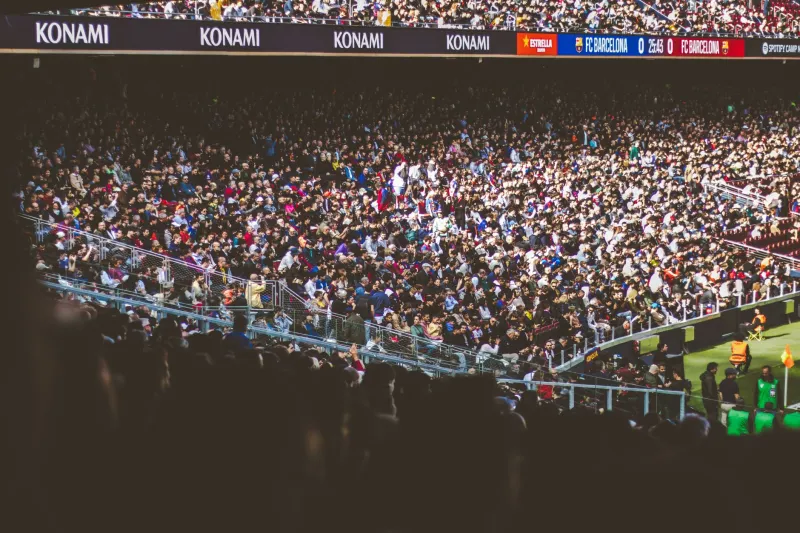
There's a particular kind of electricity in a packed stadium. It's the noise that rises before the whistle, the collective exhale after a near miss, the roar that seems to come from the building itself when something extraordinary happens on the field. Any serious sports fan knows that feeling. What most fans don't think about is how recently women athletes got to experience it.
For the better part of 2,800 years of organized athletic competition, that energy wasn't available to female competitors. Not because the crowds weren't interested. Because the crowds weren't allowed.
Ancient Greece: Exclusion by Design
The ancient Olympic Games, launched in 776 BC at Olympia in honor of Zeus, were an explicitly male institution. Not just in terms of participation — in terms of attendance. Married women were barred from entering the sanctuary at Olympia during the Games entirely. The penalty, according to ancient sources, was death. Whether that punishment was ever actually enforced is debated by historians, but the law's existence tells you everything about the cultural architecture surrounding ancient Greek athletics.
Unmarried women and girls occupied a somewhat ambiguous space in the rules, and some accounts suggest they were permitted to watch from certain areas. But the general principle was clear: organized sport was a male space, a male ritual, and a male spectacle. Women existed in relation to it — as wives of champions, as priestesses in the surrounding religious ceremonies — but not as participants in the competitive drama itself.
The Greeks did have a women's athletic festival, the Heraia, held at Olympia in honor of the goddess Hera. Female runners competed in a shortened version of the stadium race, wearing tunics with one shoulder bare. But the Heraia operated separately from the main Games, drew smaller crowds, and occupied a distinctly secondary cultural position. It was acknowledgment, not equality.
The crowd that matters in sport — the crowd that generates pressure and noise and the kind of collective energy that pushes athletes past what they thought they could do — was simply not part of women's athletic experience for most of recorded history.
The Long Silence of the Modern Era
When Pierre de Coubertin revived the Olympic Games in Athens in 1896, he was explicit about his vision: the modern Olympics were designed for male athletes. Women were not included in the program. Coubertin's reasoning was openly rooted in Victorian gender ideology — he believed female athletic competition was neither aesthetically appropriate nor physically advisable.
Women began appearing in the Olympic program gradually and grudgingly. A handful competed in tennis and golf at the 1900 Paris Games, more by circumstance than design. Track and field events for women weren't included until 1928 in Amsterdam — and even then, the reaction from the male sporting establishment was hostile. When several runners collapsed after the 800 meters final, newspapers across the US and Europe declared women constitutionally unfit for distance running. The 800 meters was pulled from the women's program and didn't return until 1960.
Through the first half of the twentieth century, women's athletic events — when they existed at all — were typically scheduled into smaller venues, given shorter broadcast windows, and treated as supporting acts rather than main events. Crowds reflected those expectations. If the institution signals that something is secondary, audiences tend to take the hint.
The Moments That Started to Change Everything
Cultural shifts in sports rarely happen in straight lines. They happen in moments — specific, charged instances when something clicks for an audience and the relationship between spectators and athletes suddenly feels different.
Billie Jean King's 1973 Battle of the Sexes match against Bobby Riggs drew 30,492 people to the Houston Astrodome and an estimated 90 million television viewers worldwide. It was as much spectacle as sport, but its effect on how Americans thought about women's athletic competition was real and lasting. The crowd in that arena wasn't there out of obligation or novelty. They were invested. Emotionally, loudly, genuinely invested.
Title IX, passed in 1972, began reshaping the pipeline. As more American girls grew up playing competitive sports at the high school and collegiate level, the audience for women's athletics expanded organically. Fans are often made before they know they're fans — through participation, through familiarity, through growing up watching something matter to the people around them.
The 1999 FIFA Women's World Cup final at the Rose Bowl in Pasadena put 90,185 people in the seats — still one of the largest crowds ever to watch a women's sporting event anywhere in the world. Brandi Chastain's penalty kick celebration became one of the most reproduced images in American sports photography. That wasn't just a game. That was a signal flare.
What a Full Stadium Actually Does
Here's the thing about crowds that gets undersold in sports history: they don't just witness performance. They shape it.
Sports psychology research has consistently demonstrated that crowd energy affects athlete output — not just through the abstract psychological boost of feeling supported, but through measurable physiological responses. Heart rate, adrenaline, pain tolerance, decision-making speed — all of these shift in environments where a crowd is genuinely engaged. Home field advantage is real, and it's partly neurochemical.
For generations of women athletes competing in half-empty venues, that physiological amplifier simply wasn't available. The performances those athletes produced were remarkable given what they were working with. The performances being produced now — in front of sold-out crowds at the NWSL, in packed arenas during March Madness, in the electric atmosphere of recent women's Olympic programs — are being generated with a different kind of fuel.
The 2023 FIFA Women's World Cup drew record global viewership. The WNBA's 2024 season broke attendance records that had stood for decades. College volleyball finals are selling out arenas that NBA teams play in. Something structural has shifted.
The Starting Line Was Always There
The ancient Greeks built their athletic world on the belief that competition produced excellence, that striving in front of witnesses was how human beings demonstrated their highest capacity. They were right about that. They were just catastrophically wrong about who got to participate — and who got to watch.
The roar in a women's sports venue today isn't new enthusiasm. It's a sound that was always possible, always waiting, just systematically prevented from happening. Every packed stadium at a women's event is a kind of correction — a crowd filling a space that should never have been empty.
Where every record has a starting line, the starting line for women's sports crowds was moved back further than it ever should have been. The athletes of today are finally getting to run the full race.