The Machine That Stopped Cheaters: Ancient Greece's Answer to the False Start
The Machine That Stopped Cheaters: Ancient Greece's Answer to the False Start
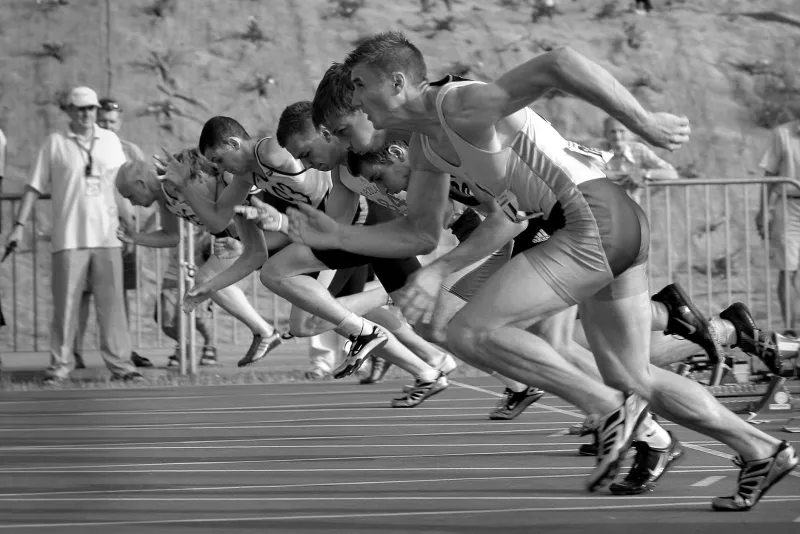
At the 2016 Rio Olympics, American sprinter Trayvon Bromell felt the starting blocks beneath him, waited for the gun, and exploded forward. Electronic sensors in the blocks registered his reaction time to the millisecond. Officials had the data they needed to confirm a clean start before he'd run ten meters. The technology was seamless, invisible, and nearly instantaneous.
 Photo: Rio Olympics, via ahaslides.com
In 400 BC at Olympia, Greek engineers were trying to solve the exact same problem with wood, rope, and a surprisingly clever piece of mechanical engineering. The tool they built was called the hysplex, and it was the ancient world's best answer to one of competitive sport's most persistent headaches: the false start.
The fact that we're still engineering solutions to this problem today — still debating the rules, still refining the sensors, still disqualifying athletes over fractions of a second — says something important about how deep this particular challenge runs. It didn't begin with Usain Bolt or Jesse Owens. It began in a Greek stadium carved into a hillside, where athletes had already figured out that a head start was worth everything.
Why the False Start Exists in the First Place
To understand why ancient Greeks needed to invent a starting mechanism, you have to understand what was at stake. The footraces at Olympia weren't friendly competitions. Winning meant glory, civic honor, free meals for life back home, and the kind of fame that could last generations. Athletes trained for years, traveled hundreds of miles, and competed in front of crowds estimated in the tens of thousands. The difference between first and second place was everything.
That kind of pressure creates cheating. Ancient sources are explicit about athletes attempting to get a jump on their competitors at the start — essentially the same problem modern track officials deal with every time a world-class sprinter lines up in the blocks. The ancient Greeks called it a false start, and the penalties were real: officials known as the Hellanodikai, the judges of the games, were authorized to whip athletes who broke early. It was effective deterrence, but it wasn't a preventative solution. You still needed a mechanism that gave every runner an equal, simultaneous release.
Enter the Hysplex
Archaeologists and classical scholars have pieced together a working understanding of the hysplex from excavations at Olympia and Corinth, as well as from ancient texts and pottery illustrations. What they found was more mechanically sophisticated than you might expect from a civilization working without electronics, hydraulics, or precision manufacturing.
The hysplex was a starting gate — a horizontal barrier, likely made of rope or cord stretched between upright posts, positioned in front of the runners at the starting line. The critical innovation was in how it released. Rather than having an official simply drop or cut the barrier — which introduced human reaction time and the possibility of inconsistent releases — the hysplex was designed to fall forward simultaneously along its entire length when triggered. Some reconstructions suggest a cord-and-peg system that allowed a single official to release the entire gate at once, dropping it flat to the ground in front of the runners and clearing the lane in a single motion.
What this accomplished was significant: it gave every runner an identical visual cue at exactly the same moment. When the barrier dropped, you ran. There was no advantage to be gained by watching an official's hand or anticipating a verbal command. The gate was either down or it wasn't.
Excavations at the ancient stadium in Corinth have uncovered grooves in the starting stone blocks that appear designed to anchor the posts of a hysplex system, giving archaeologists physical evidence of how the device was integrated into the track itself. This wasn't an improvised solution — it was built into the infrastructure of the venue.
From Rope Gates to Electronic Blocks
The history of the starting mechanism between ancient Greece and the modern Olympics is, in broad strokes, a story of the same problem being solved with progressively better tools.
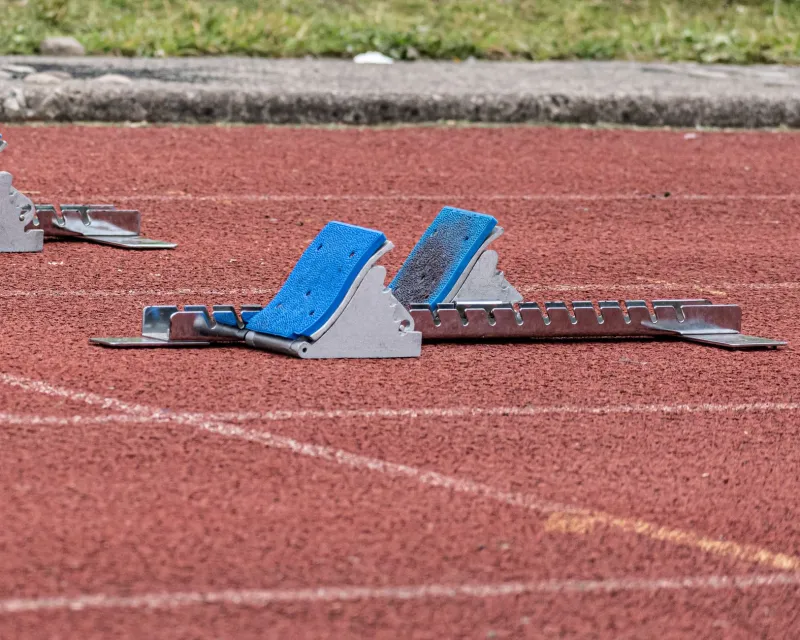
The earliest modern Olympic Games in 1896 used a relatively simple approach: a starter's pistol and a verbal command, with athletes starting from standing positions. The crouch start — which dramatically improves acceleration — wasn't widely adopted until the late 19th century, pioneered by American sprinter Charles Sherrill, who reportedly borrowed the idea from watching dogs and kangaroos. Starting blocks became standard equipment in the 1930s, giving athletes a fixed surface to push against and eliminating the practice of digging holes in the track.
But the false start problem remained. Officials watched for early movement, made judgment calls, and sometimes got it wrong. The introduction of electronic sensors in the starting blocks, which became standard in major international competition during the late 20th century, was the most significant leap forward since the ancient hysplex. Modern systems can detect movement in the blocks within milliseconds of the starting signal, and the International Association of Athletics Federations (World Athletics) has established a 100-millisecond threshold — the time considered the minimum possible human reaction time — below which a start is automatically ruled false.
That threshold has itself become a source of controversy. Some sports scientists argue the 100ms rule is too rigid, that elite athletes may be capable of legitimate reactions faster than the threshold allows. The debate is ongoing. Even with sensors that measure to thousandths of a second, the question of what constitutes a fair start still doesn't have a universally agreed-upon answer.
The Same Finish Line, Different Tools
What's striking about this history is how consistent the underlying goal has been across 2,400 years. Greek engineers building the hysplex and American sports technology companies developing piezoelectric pressure sensors in starting blocks were solving the same problem: how do you guarantee that every competitor begins from the same position, at the same moment, with no advantage granted by timing or anticipation?
The tools are almost incomparably different. The ambition is identical.
Every time a sprinter settles into the blocks at a major American track meet — at the NCAA Championships, at the US Olympic Trials, at a Diamond League event in Eugene — they are participating in a chain of engineering problem-solving that stretches back to a Greek stadium where officials were still working out how to make competition genuinely fair.
The hysplex didn't survive into the modern era. The problem it was designed to solve never went away. That's the kind of continuity that makes sports history worth paying attention to — not just the records and the champions, but the persistent, unglamorous engineering challenge of making the starting line mean the same thing for everyone who stands behind it.