From Open Water to Gold: The Ancient Roots of America's Most Dominant Olympic Sport
From Open Water to Gold: The Ancient Roots of America's Most Dominant Olympic Sport
Before there were lanes, before there were goggles, before there was a stopwatch counting down to hundredths of a second — there was just water, and the very human need to get through it without drowning.
Swimming is one of the oldest physical skills in human history, and it's also the sport where the United States has been most consistently, almost ruthlessly, dominant at the Olympic level. American swimmers have won more Olympic gold medals than any other nation across the history of the modern Games. That dominance didn't happen by accident, and it didn't start in a chlorinated pool. It started in the rivers and seas of the ancient world.
Ancient Water: Survival First, Sport Second
The earliest evidence of human swimming dates back roughly 10,000 years. Cave paintings in what is now Libya depict figures in what appears to be a swimming stroke. Ancient Egyptian hieroglyphics from around 2500 BC show swimmers in motion. Assyrian stone carvings from the 9th century BC feature military figures crossing rivers using rudimentary strokes.
For ancient Greeks, Romans, and Egyptians, swimming wasn't recreation — it was a survival competency. Greek soldiers were expected to swim. Homer's Iliad and Odyssey are filled with seafarers and warriors navigating open water. The Romans trained their legions in river crossing. The phrase "he can neither read nor swim" was an ancient Greek insult reserved for the utterly uneducated — swimming was considered that fundamental a life skill.
Despite all this, competitive swimming didn't make it into the ancient Olympic Games at Olympia. The Games focused on land-based events — running, jumping, throwing, and combat sports. Open water was too unpredictable, too variable to serve as a fair competitive arena by the standards of the time. Swimming remained in the category of useful skill rather than formalized sport for most of the ancient period.
The Long Road to Organized Competition
Structured swimming competition emerged slowly in Europe. Japan has records of organized swimming contests dating to 36 BC, making it one of the earliest nations to treat the activity as a formal sport. In Europe, competitive swimming didn't gain real traction until the 19th century, when indoor pools began appearing in Britain and swimming clubs started organizing races.
The dominant stroke of the early competitive era was a head-above-water breaststroke — slow, inefficient, but familiar. When swimmers from indigenous cultures in the Americas and Australia began demonstrating overarm techniques at international meets in the mid-1800s, European competitors were initially dismissive. The overarm crawl looked too aggressive, too splashy. British swimmers stuck with their breaststroke.
That stubbornness cost them dearly. The front crawl — refined from those indigenous techniques into what we now call freestyle — was dramatically faster, and once the competitive world accepted it, records tumbled. The evolution of swimming from a single stroke to a multi-discipline sport featuring freestyle, backstroke, breaststroke, and butterfly took most of the late 19th and early 20th centuries to complete.
Athens 1896 and the Birth of Olympic Swimming
When the modern Olympics launched in Athens in 1896, swimming was on the program — but barely resembling what we'd recognize today. The events were held in the open waters of the Bay of Zea, near Piraeus. Water temperatures hovered around 55 degrees Fahrenheit. There were no lanes, no starting blocks, no electronic timing. Athletes were ferried out to their starting positions by boats and jumped in.
 Photo: Bay of Zea, via c8.alamy.com
Hungarian swimmer Alfréd Hajós won two gold medals at those Games — the 100-meter and 1200-meter freestyle events — and later described the experience as a genuine fight for survival in the cold, choppy sea. "My will to live," he reportedly said, "completely overcame my desire to win."
American swimmers were present at Athens but didn't dominate those earliest Games. That would come later, as the United States built the infrastructure — the pools, the coaching systems, the club programs — that would eventually make American swimming the envy of the world.
How America Built a Swimming Machine
The American swimming dynasty didn't emerge from a single moment. It was constructed over decades through a combination of factors that mirror what ancient Greek city-states did with their own athletic programs: systematic investment, early identification of talent, and a competitive culture that treated excellence as the baseline expectation rather than the exception.
By the mid-20th century, the United States had developed a dense network of age-group swimming programs feeding into college powerhouses feeding into Olympic teams. The AAU, later USA Swimming, created a pipeline that other nations spent generations trying to replicate. Names like Johnny Weissmuller, Mark Spitz, and eventually Michael Phelps became synonymous with American athletic supremacy in a way that no other single sport could match.
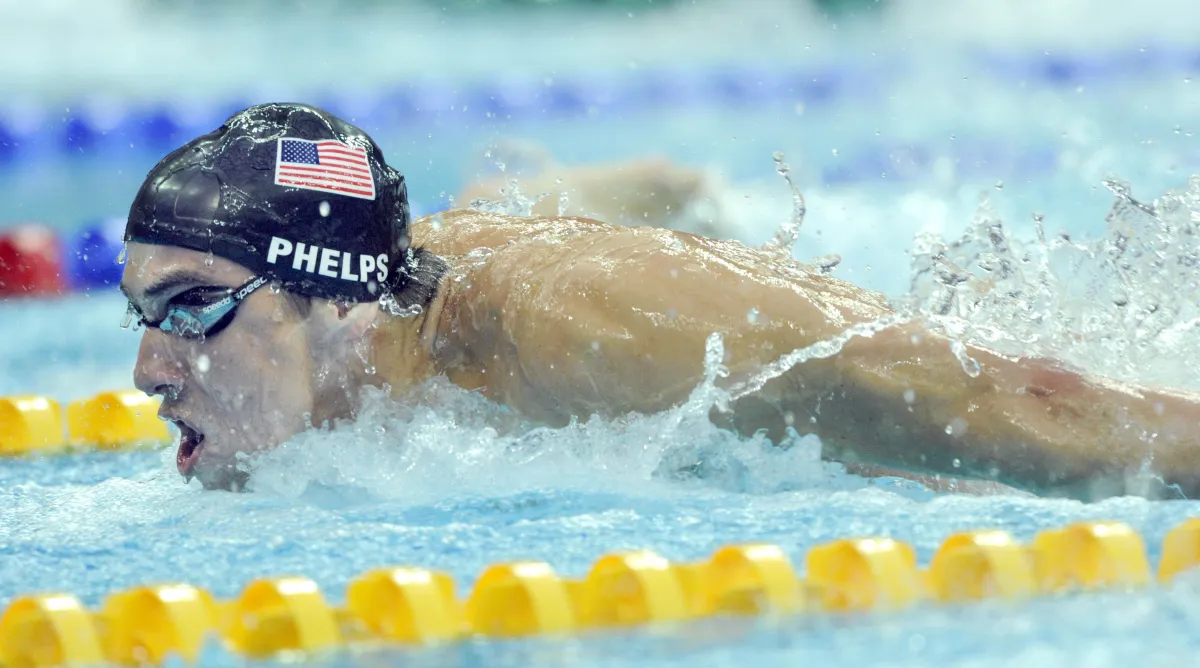 Photo: Michael Phelps, via library.sportingnews.com
Mark Spitz's seven gold medals at the 1972 Munich Olympics — each in a world-record time — announced to the world that American swimming had reached a different level entirely. Thirty-six years later, Michael Phelps eclipsed that record with eight golds in Beijing, then accumulated 23 career Olympic gold medals across four Games, a total that no athlete in any sport in Olympic history has matched.
Technology's Role in Rewriting the Record Books
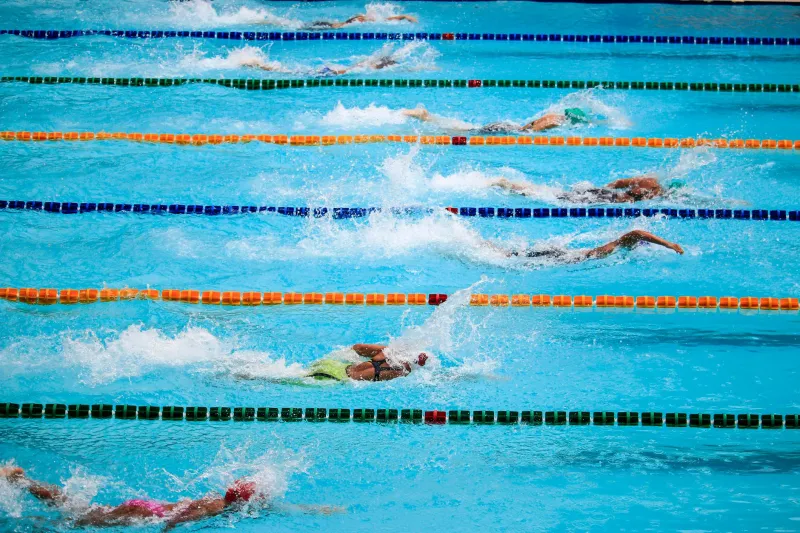
Swimming's records haven't improved simply because athletes got better. Technology has played a dramatic role. The introduction of polyurethane full-body suits in the late 2000s produced a wave of world records so unprecedented that FINA, the sport's governing body, banned the suits entirely in 2010. In a two-year window, nearly every world record in the sport was broken — some multiple times.
This mirrors a broader pattern across Olympic history: equipment and technology repeatedly intervene to separate eras of performance. Ancient Greek athletes competed barefoot on sand and clay. Modern swimmers race in precision-engineered suits in temperature-controlled pools with underwater cameras and touchpad timing accurate to thousandths of a second. The human beings aren't entirely different — the systems built around them are almost unrecognizable.
Why the Ancient Connection Still Resonates
There's something worth pausing on when you watch an American swimmer climb onto the starting block at the Olympics. The chain of human experience connecting that moment to an ancient Egyptian soldier wading through the Nile, or a Greek sailor fighting open water off the Aegean coast, is real and unbroken.
Swimming began as the most basic form of physical survival. It became the sport where the United States has most completely demonstrated what modern athletic development can achieve. Every gold medal is a data point in a story that started long before anyone thought to keep score.