Equal Ground: The Ancient Greek Engineers Who Made Sure Every Race Started Fair

Somewhere in the ruins of ancient Olympia, buried under centuries of silt and sediment, archaeologists found something deceptively simple: two parallel grooves carved into a long slab of stone. No bronze. No mechanism. No moving parts. Just rock, precision, and intention.
Those grooves were the starting line of the ancient world — and the moment researchers understood what they were looking at, the history of athletic competition snapped into focus. The ancient Greeks weren't just running races. They were engineering fairness.
Cutting Fairness Into Stone
The device was called the balbis, and it served as the official starting apparatus at the ancient Olympic Games in Olympia. Constructed from limestone, the balbis featured two parallel grooves spaced roughly shoulder-width apart, running the full width of the track. Each competitor planted their toes in the grooves, feet staggered, and waited for the signal.
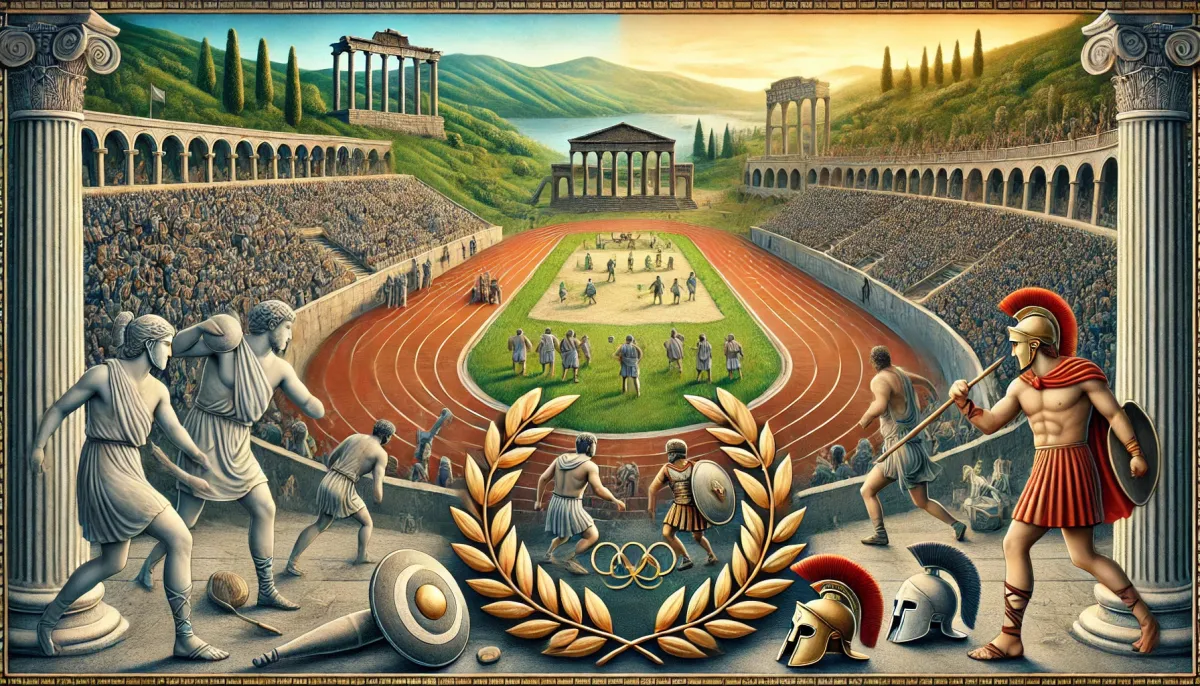 Photo: ancient Olympic Games, via ancienthistoryguide.com
The design wasn't accidental. Greek engineers understood that a staggered or uneven start — where one runner's toes were inches ahead of another's — could determine the outcome of a race before a single stride was taken. In a competition where the margin between glory and obscurity was razor-thin, those extra inches mattered enormously.
The grooves forced every athlete into the same stance, the same position, the same moment of tension before release. That was the whole point.
The track at Olympia, called the stadion, measured approximately 600 Greek feet — roughly 192 meters — of packed earth and sand. The starting line was fixed. The rules were fixed. The only variable was the athlete.
The Starting Post and the Earliest Mechanisms
Beyond the carved stone, Greek officials developed a rudimentary starting gate mechanism called the hysplex. Essentially a rope or bar held horizontally across the starting positions, the hysplex dropped simultaneously for all competitors when released by an official. It was ancient sport's answer to the modern starting gun — a single unified signal that gave no runner an advantage.
The sophistication of this system is easy to underestimate. These weren't informal foot races between friends. The ancient Olympics drew athletes from across the Greek world, representing city-states with enormous political stakes in the outcome. Elis, the city-state that administered the Games, employed officials called Hellanodikai — judges of the Greeks — whose job was to enforce the rules and ensure no competitor cheated the start.
False starts were penalized. In some accounts, athletes who broke before the signal were flogged in front of the crowd. The Greeks took procedural fairness that seriously.
Why Fairness at the Start Mattered So Much
To understand why the Greeks invested so heavily in engineering a fair start, you have to understand what winning meant in ancient Greek culture. There was no silver medal. No consolation prize. The winner received an olive wreath, eternal glory, and a hero's welcome back home. The loser received nothing — not even polite applause.
In that context, the integrity of the competition wasn't just a sporting concern. It was a cultural and religious one. The Olympic Games were held in honor of Zeus. A race decided by an unfair start wasn't just a bad result — it was a corruption of something sacred.
The balbis and the hysplex were, in their way, religious instruments as much as athletic ones. They guaranteed that when a champion crossed the finish line, the gods had witnessed a legitimate contest.
From Stone Grooves to Starting Blocks
The direct line between the balbis and the modern starting block is surprisingly straight. When track and field formalized its rules in the 19th and early 20th centuries, the central problem — how do you give every sprinter an identical launch position — was exactly the same one Greek engineers had solved in stone.
Modern starting blocks, introduced at the 1948 London Olympics as standard equipment, operate on the same philosophical premise: every runner gets the same angle, the same resistance, the same mechanical advantage at the moment of departure. The materials changed from limestone to aluminum and carbon fiber. The precision improved from hand-carved grooves to biomechanically calibrated platforms. But the goal never changed.
Today, World Athletics — the governing body for track and field — mandates specific block configurations, reaction time minimums (any reaction under 0.1 seconds is automatically ruled a false start), and uniform starting procedures. The false start rules are, in spirit, a direct descendant of the Greek system that flogged athletes for breaking too early.
The Level Playing Field as America's Sporting Religion
For American sports fans, the concept of a level playing field is practically a founding principle. We argue about it constantly — whether the salary cap is fair, whether the playoff seeding makes sense, whether the officiating crew is calling it straight. The obsession runs deep.
That obsession has ancient roots. The Greeks understood, long before anyone had the vocabulary for it, that competition only carries meaning when the starting conditions are equal. A race where one runner gets a head start isn't a test of athletic ability — it's theater. The balbis was the Greeks' way of insisting that what happened between the start and the finish line was the only thing that mattered.
Every time a sprinter at the US Olympic Trials settles into the blocks, waits for the starter's command, and explodes off the platform in pursuit of a Paris or Los Angeles berth, they are participating in a ritual that is 2,800 years old. The technology is different. The stakes are different. The shoes are definitely different.
But the line in the ground — the one that says everyone starts here, everyone starts equal — that line has never moved.
The Starting Line Is Still the Story
Sport Origins exists because every record has a starting line. In this case, that phrase is almost embarrassingly literal. The modern track meet begins at the same conceptual location where Greek engineers knelt in the dust at Olympia and carved two parallel grooves into a slab of limestone.
Fairness at the start wasn't a modern invention. It was an ancient obsession. And the fact that we're still arguing about reaction times, block configurations, and false start rules in the 21st century is proof that the Greeks got the question exactly right — even if they had to carve it in stone to make it stick.