The Race That Moved: Ancient Greece's Strangest Experiment in Fair Competition
Walk into any modern track facility and one thing is non-negotiable: the starting line doesn't move. Whether you're a middle school sprinter or an Olympic finalist, the distance is fixed, the lanes are standardized, and the conditions — within reason — are identical for everyone. Fairness, in the modern athletic imagination, means sameness.
Ancient Greece didn't see it that way.
Among the more peculiar practices documented in the historical record of early Greek athletic competition is a system of adjustable starts — a method of organizing races in which the starting position wasn't fixed but shifted based on a runner's performance in preliminary heats. It's a concept so foreign to modern sports thinking that it reads almost like a mistranslation. But understanding why the Greeks tried it, and why it eventually disappeared, reveals something genuinely interesting about how human societies have always argued over what fair actually means.
Competition Before Standardization
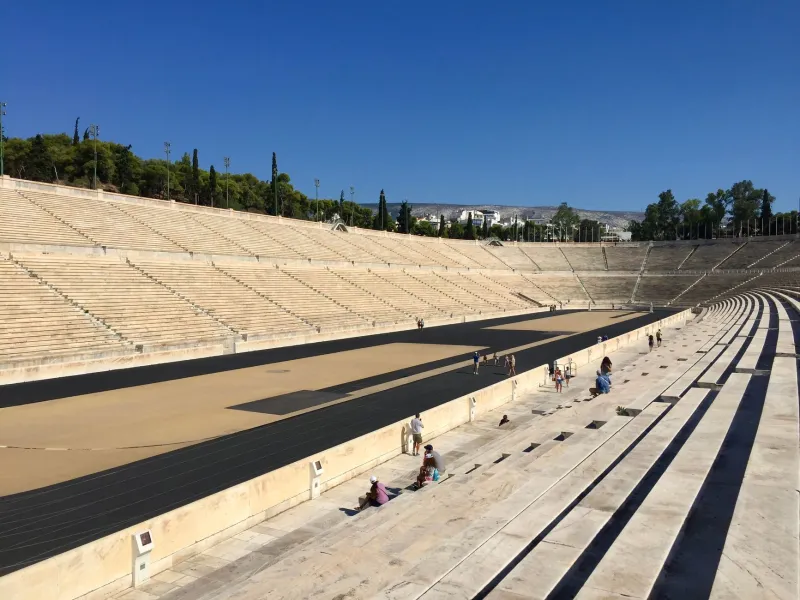
The ancient Olympics, which began in 776 BC at Olympia, were not the tightly regulated international spectacle we associate with the modern Games. Early competitions were organized around religious ceremony as much as athletic achievement. The stadium — the primary running surface — was a sacred space, and the rules governing it evolved slowly and inconsistently across different city-states and regional festivals.
Before the formal Olympic program expanded to include multiple running distances, regional Greek athletic festivals operated with considerable variation in how races were structured. Qualifying heats existed in various forms, and judges — the Hellanodikai — held significant authority over how competitions were organized and conducted. Their power wasn't just ceremonial. They could disqualify athletes, adjust conditions, and interpret rules with genuine discretion.
It's within this flexible, pre-standardized environment that the adjustable starting line makes historical sense. The Greeks weren't being inconsistent. They were experimenting.
How the System Actually Worked
The core logic behind adjusting starting positions was rooted in a Greek concept of competitive equity that differs sharply from modern thinking. Where today's system treats equal conditions as the foundation of fair competition, some ancient Greek frameworks treated equal opportunity for glory as the goal — which sometimes meant unequal conditions.
In practice, the system worked roughly like this: athletes who performed exceptionally well in preliminary heats — demonstrating clear superiority over the field — might find their starting position adjusted in subsequent rounds, effectively giving slower competitors a head start. The intent wasn't to handicap excellence but to ensure that races remained genuinely contested rather than foregone conclusions. A race in which one athlete was so dominant that the outcome was obvious before the starting signal wasn't considered a satisfying demonstration of athletic virtue. Drama and uncertainty were part of the point.
This isn't entirely alien to modern sports, actually. Handicap systems exist across golf, horse racing, and rowing precisely because pure performance gaps can make competition feel hollow. The Greeks were working through the same tension — just with a moving stone rather than a stroke differential.
Why the Idea Didn't Last
The adjustable start system was never universal, and its decline tracks closely with the formalization of the Olympic program and the rise of the professional athletic culture that developed through the fifth and fourth centuries BC.
As the Games grew in prestige and the stakes attached to victory increased — victors received not just an olive wreath but lifetime privileges, financial rewards from their home city-states, and the kind of fame that could persist for generations — the tolerance for administrative flexibility shrank. Athletes and their city-states invested heavily in preparation. The idea that a judge could adjust the competitive landscape based on subjective assessments of performance became increasingly contentious.
There's also a deeper philosophical shift at work. Early Greek athletic culture was embedded in a broader concept of arete — excellence as a holistic virtue. Athletic competition was one expression of that virtue, but not the only measure of a man's worth. As the Olympics became more specialized and the athlete's identity became more narrowly defined by competitive results, the meaning of victory shifted. Winning under modified conditions started to feel less like glory and more like an asterisk.
What Ancient Greece Got Right — and Wrong
From a modern American sports perspective, the adjustable starting line looks like a failed experiment. We've built our entire athletic culture on the idea that records are meaningful precisely because the conditions that produced them are replicable. Roger Bannister's four-minute mile means something because anyone can stand at the same starting line and attempt the same distance. Adjustable starts would make that kind of comparison impossible.
But the Greeks were asking a question that never fully goes away: what is competition actually for? If the answer is to identify the single fastest human being, then identical conditions make sense. If the answer is to produce the most compelling, uncertain, genuinely dramatic contest — the kind that holds a crowd and generates stories worth retelling — then maybe the Greeks were onto something.
Modern sports haven't fully resolved this tension. We seed brackets. We use salary caps. We assign draft picks in reverse order of finish. We do all kinds of things to manufacture competitive balance that the Greeks would have recognized as philosophically continuous with their moving starting line.
The stone that got repositioned before each race at an ancient Greek festival is gone. But the argument it represented — about what fair really means when talent isn't evenly distributed — is still being had in every commissioner's office and competition committee in American sport.
Every system has a starting line. Ancient Greece just wasn't sure where to put it.