Gone From the Program: The Ancient Olympic Events Nobody Brought Back in 1896
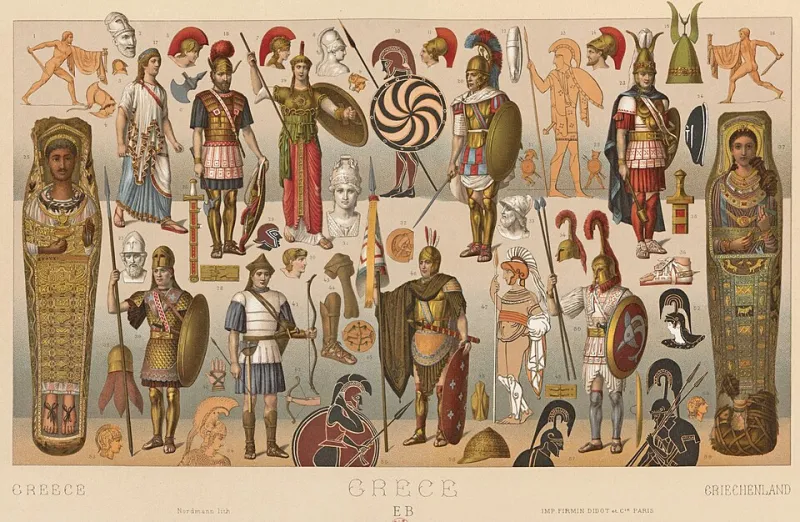
Photo: Racinet, Albert (1825-1893), Public domain, via Wikimedia Commons
When the modern Olympics came back to life in Athens in 1896, the organizers made a lot of decisions about what the Games would look like. Track events, field events, gymnastics, swimming—the basic architecture felt both new and familiar, a blend of contemporary sport and ancient inspiration. Coubertin and his committee wanted to honor the Greek tradition while building something the modern world could actually run.
What they quietly skipped over is just as interesting as what they kept.
The ancient Olympics featured competitions that were, by any modern standard, bizarre—and by any athletic standard, genuinely demanding. Some were abandoned because they were too violent for a 19th-century audience. Some disappeared because the cultures that sustained them collapsed. And some simply had no modern equivalent anyone knew how to build.
Here's what we lost.
Pankration: The Sport That Made MMA Look Tame
If you've ever watched a UFC fight and thought it seemed intense, you haven't met pankration.
Introduced to the ancient Olympics in 648 BC, pankration was a full-contact combat sport with almost no rules. Competitors could punch, kick, choke, and apply joint locks. They could take the fight to the ground. They could do essentially anything except bite or gouge eyes—rules that ancient sources suggest were enforced inconsistently at best.
Matches ended when one competitor submitted, lost consciousness, or died. That last outcome was rare but not unheard of. Ancient sources record at least one case of a pankration champion being awarded a posthumous victory after dying during a match while simultaneously forcing his opponent to submit.
The athletes who competed in pankration weren't brawlers. They were trained specialists who combined the striking skills of boxers with the grappling techniques of wrestlers—a combination that wouldn't look out of place in a modern mixed martial arts gym. Ancient Greek trainers understood that different combat situations called for different techniques, and pankration athletes drilled both.
By the time Coubertin was designing the 1896 program, pankration had been dead for fifteen centuries. Reviving it would have required either sanitizing it beyond recognition or presenting something that Victorian society absolutely wasn't ready for. It stayed on the shelf.
The irony? MMA—essentially a modern reinvention of pankration's core concept—is now one of the fastest-growing combat sports in the United States. The ancient Greeks were ahead of schedule by about 2,600 years.
The Hoplitodromos: Running in 50 Pounds of Bronze
The ancient Olympics included a foot race that modern athletics has never come close to replicating: the hoplitodromos, or race in armor.
Competitors ran the length of the stadium—roughly 192 meters—wearing a bronze helmet, bronze shin guards, and carrying a heavy shield. The total weight of the equipment was somewhere between 40 and 60 pounds, depending on the armor. This was the full kit of a Greek infantry soldier, and the race was explicitly tied to military readiness. The event celebrated the ability to move fast under combat conditions.
It was also, by any account, absolutely brutal. Running at sprint pace in bronze armor, especially in the Greek summer heat, was a test of physical conditioning that combined strength, endurance, and heat tolerance in ways no modern track event demands. The athletes who excelled at it were a specific type—powerful, heat-adapted, and strong enough to maintain form while carrying the equivalent of a large toddler strapped to their arms and legs.
No modern equivalent exists in the Olympic program. The closest thing might be military obstacle course competitions, which have developed their own competitive circuit outside the Olympics entirely. But the hoplitodromos as a standalone event? Gone completely.
The Pentathlon's Forgotten Cousin: The Combined Events That Never Returned
The ancient pentathlon—sprint, long jump, discus, javelin, wrestling—is well-documented and was deliberately echoed in the modern decathlon and heptathlon. But the ancient Olympics also featured combined structures and event pairings that didn't survive the translation.
Ancient boxing, for instance, had no weight classes and no rounds. Fighters went until one man couldn't continue. Bouts sometimes lasted hours. The fighter who trained for ancient Olympic boxing wasn't just a skilled striker—he was a conditioning athlete who needed to be capable of sustained combat far beyond what modern boxing demands.
The diaulos—a two-length race, roughly 400 meters—and the dolichos—a long-distance event that may have been as far as 4,800 meters—both existed in ancient competition but were structured around the specific dimensions of ancient stadiums. When modern athletics standardized distances in meters, these events didn't map neatly onto anything, and they were quietly absorbed into the track program without much ceremony.
Why These Events Disappeared
The disappearance of ancient Olympic events wasn't random. It followed a pattern.
Violent sports—pankration, ancient boxing—survived as long as the cultural context that valued them did. Once Rome absorbed Greek culture and then Christianity reshaped Roman values, the celebration of athletic violence became harder to sustain institutionally. The festivals that housed these competitions faded. The training traditions attached to them faded with them.
Military events like the hoplitodromos became irrelevant when the military technology they celebrated became obsolete. Bronze armor was replaced by different equipment, then by gunpowder, then by technologies that made individual physical conditioning a smaller part of military effectiveness. A race in armor stopped making cultural sense.
And the combined events that didn't survive? They often required infrastructure—specific stadium dimensions, specific equipment standards—that didn't transfer into the modern context. When Coubertin's committee sat down to design the 1896 program, they were working with the sports that already existed in recognizable modern form. The events that required rebuilding an entire cultural ecosystem from scratch didn't make the cut.
What the Lost Events Tell Us
There's a version of the Olympics that includes pankration alongside wrestling, the hoplitodromos alongside the 100-meter dash, and ancient boxing's no-rounds format alongside the modern version. It would be a stranger, more violent, more physically demanding Games than anything we've seen in the modern era.
But it would also be a more complete picture of what athletic competition actually looked like for a thousand years of human history. The events that disappeared weren't footnotes. They were central to how ancient Greeks understood physical excellence, military readiness, and the relationship between the human body and its limits.
Every sport in today's Olympic program has a starting line. Some of the most interesting starting lines lead back to events that never made it onto the modern track at all.