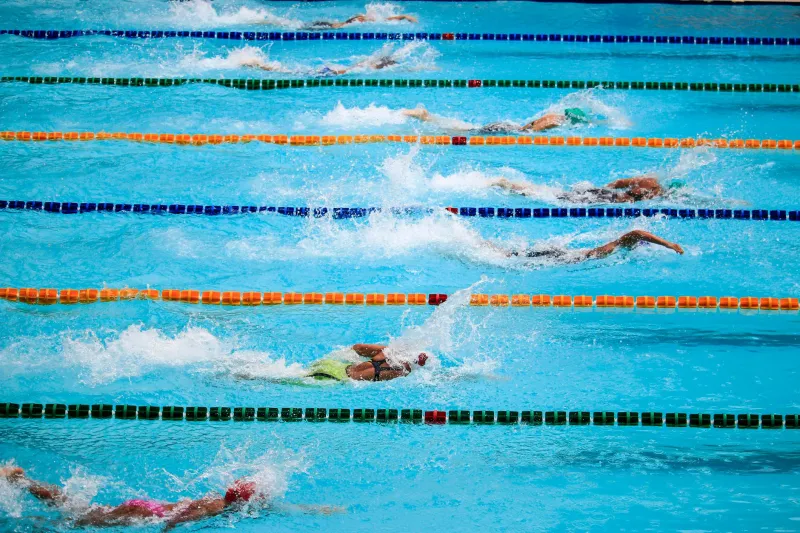
Before Numbers Mattered: How Ancient Greeks Created the Blueprint for Chasing Greatness
The Stone Tablets That Started It All
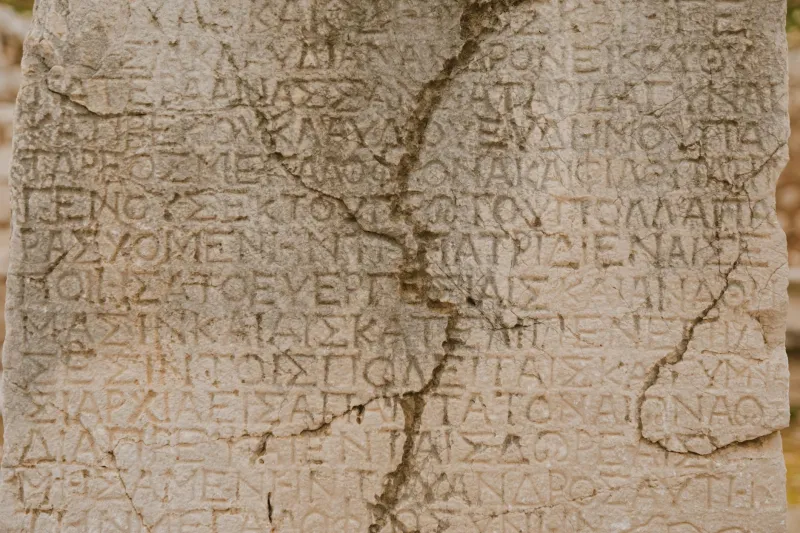
Walk through the ruins of ancient Olympia today, and you'll find something that would feel familiar to any sports fan: records carved in stone. Not times or distances—those wouldn't come for another two millennia—but something more powerful. Names. Achievements. Claims to being the greatest.
These weathered inscriptions represent humanity's first attempt at what we now call record-keeping, though the Greeks had no concept of a "world record" as we understand it. Instead, they created something more enduring: the idea that athletic achievement could transcend a single moment and become part of history.
When Victory Was About More Than Winning
The ancient Greeks didn't measure success in seconds or meters. They measured it in something harder to quantify but impossible to ignore: arete, or excellence that approached the divine. When a sprinter won the stadion race at Olympia, he wasn't just faster than the other runners that day—he was claiming his place among the greatest athletes who had ever lived.
This mindset created the world's first performance culture. Athletes didn't just train to win; they trained to be remembered. The stone inscriptions at Olympia weren't just scorecards—they were humanity's first hall of fame, where champions declared their greatness for all time.
Consider Leonidas of Rhodes, who won twelve Olympic crowns across four Games between 164-152 BC. His achievements were carved into stone not because someone was keeping official records, but because his contemporaries recognized they were witnessing something unprecedented. That inscription survived 2,000 years, making Leonidas arguably history's first recorded sports legend.
 Photo: Olympic Games, via wallpaperaccess.com
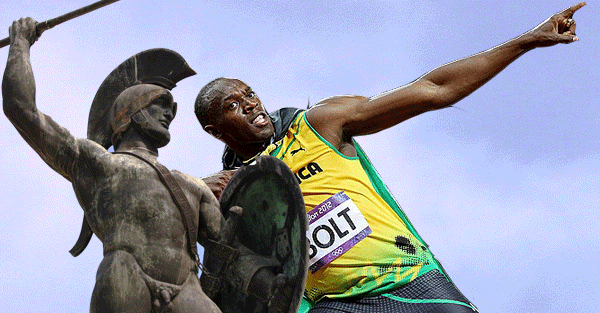 Photo: Leonidas of Rhodes, via cdn.sovereignman.com
The Psychology of Ancient Excellence
What drove these ancient athletes wasn't prize money or endorsement deals—Olympic victors received only an olive wreath. Instead, they were chasing something more valuable: immortality through achievement. The Greeks believed that exceptional athletic performance was a way of touching the divine, of proving that humans could transcend their limitations.
This philosophy created the template for every record chase that followed. When Usain Bolt lowered the 100-meter world record to 9.58 seconds in 2009, he was operating under the same fundamental drive that motivated ancient Greek sprinters: the desire to prove that human potential has no ceiling.
The Greeks also understood that records exist to be broken. Their mythology is filled with stories of heroes surpassing their predecessors—Hercules completing twelve impossible labors, Perseus slaying Medusa, Achilles becoming the greatest warrior of his generation. These weren't just stories; they were cultural blueprints that taught athletes to see themselves as part of an ongoing conversation about human excellence.
From Olive Wreaths to Digital Clocks
The transition from ancient Greek achievement culture to modern record-keeping wasn't immediate. For centuries after the fall of Rome, competitive athletics largely disappeared from European culture. When the modern Olympics began in 1896, organizers had to rebuild the entire concept of international athletic competition from scratch.
But the Greek foundation was still there. Pierre de Coubertin, founder of the modern Olympics, explicitly modeled his vision on ancient Greek ideals. The Olympic motto "Citius, Altius, Fortius"—Faster, Higher, Stronger—is a direct descendant of the Greek concept of arete.
The first modern Olympic records were crude by today's standards. Timing was done by hand, measurements were approximate, and record-keeping was inconsistent. But the underlying drive was identical to what motivated ancient Greek athletes: the desire to push human performance to its absolute limits.
Why Ancient Greek Athletes Would Recognize Today's Record Culture
Modern athletes chasing world records are participating in a tradition that stretches back 2,800 years. When Katie Ledecky destroys a swimming world record, or when Karsten Warholm obliterates the 400-meter hurdles mark, they're fulfilling the same fundamental human impulse that drove ancient Greek champions to carve their names in stone.
The tools have changed—we have laser timing, video replay, and global databases—but the motivation remains identical. Athletes still train not just to win, but to be remembered. They still chase performances that will outlive them. They still believe, as the Greeks did, that human potential is unlimited.
The Eternal Starting Line
The ancient Greeks gave us more than the Olympics. They gave us the idea that athletic achievement could be permanent, that a single performance could echo across centuries, and that the pursuit of excellence was worthy of a lifetime's dedication.
Every world record broken today traces back to those first stone inscriptions at Olympia. Every athlete who steps onto a track or into a pool carries forward a tradition that began when the first Greek sprinter decided that being fastest wasn't enough—he wanted to be fastest forever.
That's the real Greek invention: not the starting line itself, but the understanding that every starting line is also a doorway to immortality. In a world obsessed with breaking records, we're still chasing the same dream that motivated athletes 2,800 years ago—the chance to prove that human beings can always go faster, jump higher, and be stronger than anyone thought possible.