Before Bannister Breathed Hard: The Ancient Athletes Who Shattered Their Own Impossible
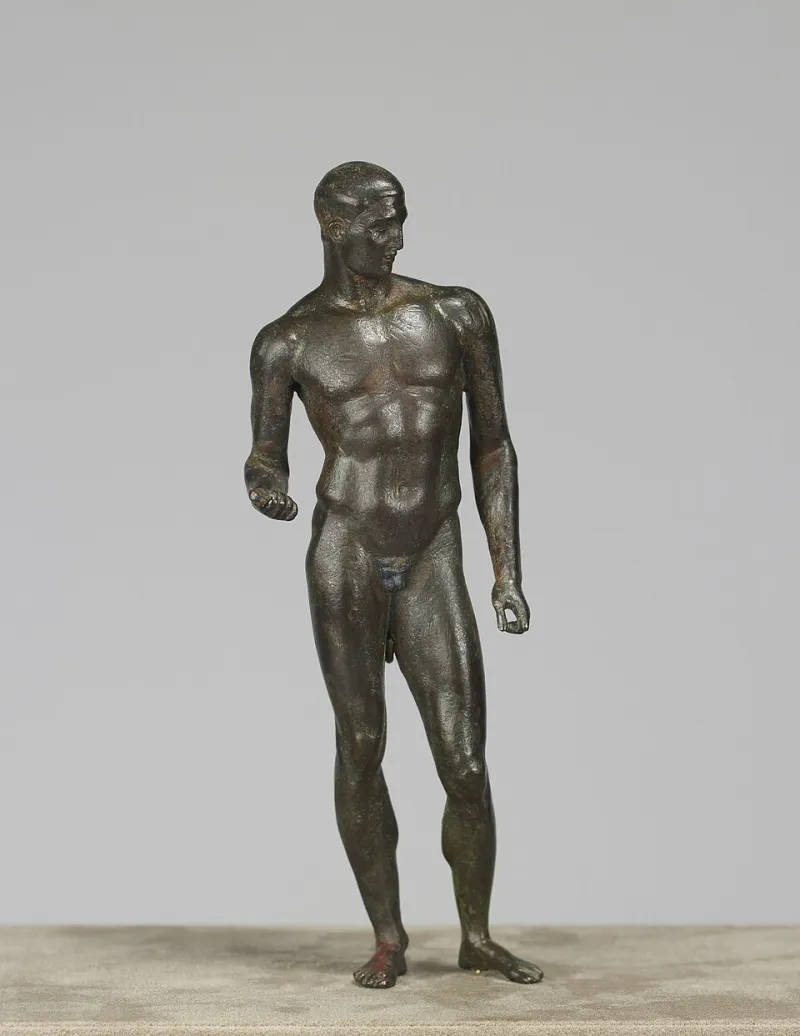
Photo: Anonymous (Greece)Unknown author, Public domain, via Wikimedia Commons
On May 6, 1954, Roger Bannister crossed a finish line in Oxford, England, and the world collectively exhaled. The four-minute mile—once considered a physiological ceiling, a hard wall built into human biology—was gone. Bannister ran 3:59.4, and within weeks, the barrier that had supposedly defined the limits of human running fell apart entirely as other athletes followed him through the door he'd opened.
It's one of the most retold stories in sports history. But here's the thing: the story of an athlete smashing a barrier that everyone assumed was permanent didn't start in 1954. It started somewhere around 776 BC, in a religious sanctuary in western Greece, and it never really stopped.
The Original Impossible Standard
The ancient Olympics didn't have a four-minute mile. What they had was something arguably more intimidating: the weight of divine expectation.
Athletes competing at Olympia weren't just trying to beat the guy in the next lane. They were performing in front of thousands of spectators at a religious festival honoring Zeus. The cultural stakes were almost incomprehensibly high. Victory meant statues, poetry, free meals for life, and the kind of civic glory that followed a champion's family for generations. Defeat, especially in high-profile events, carried a social stigma that could define a man's reputation permanently.
Inside that pressure cooker, certain athletes did things that their contemporaries considered physically impossible—and then other athletes did them too.
Milo and the Weight That Kept Getting Heavier
The most famous example is Milo of Croton, the sixth-century BC wrestler whose story has been told so many times it has acquired a mythological sheen. But strip away the legend and what you find is a genuinely remarkable athletic career: six Olympic titles in wrestling, spread across roughly two decades of competition.
The feat that made Milo legendary, though, wasn't a single match. Ancient sources describe him training by lifting a newborn calf every day, walking it across his shoulders as it grew, until eventually he was carrying a full-grown bull. Modern sports scientists recognize this immediately as progressive overload—the same training principle that underlies every serious strength and conditioning program today.
For ancient Greeks watching this, it looked like magic. How does a man get strong enough to dominate opponents for twenty years? Milo's answer—systematic, incremental loading—was the kind of breakthrough that seems obvious in hindsight and revolutionary in the moment. He wasn't just breaking performance barriers. He was rewriting the understanding of how athletic strength could be developed.
Chariot Racing and the Speed Ceiling
In chariot racing, the equivalent of Bannister's mile was surviving the hippodrome at Olympia intact. The track was notoriously dangerous, with tight turns that could send a chariot and its horses into catastrophic wrecks. Most teams didn't finish. In one famous race described by the ancient playwright Sophocles, only one chariot out of forty completed the course.
Breaking the barrier in chariot racing wasn't about going faster. It was about going faster and coming out alive—a distinction that made the sport's psychological demands unique. The drivers who figured out how to navigate the turns without sacrificing speed were doing something their competitors believed couldn't be done consistently. When they did it repeatedly, they didn't just win races. They changed what other drivers thought was achievable.
This is exactly the dynamic that played out with Bannister. Within 46 days of his sub-four-minute mile, Australian runner John Landy broke it again. Within three years, sixteen runners had done it. The barrier was never physiological. It was psychological—and ancient athletes were navigating that same terrain two and a half millennia earlier.
The Pentathlon and the Impossible Generalist
Perhaps the most psychologically demanding barrier ancient athletes faced was the pentathlon—a five-discipline event combining the stadion sprint, long jump, discus, javelin, and wrestling. The implicit assumption baked into the pentathlon was that no one could truly excel at all five disciplines simultaneously. The event was designed to find the most complete athlete, not the most specialized one.
And yet certain athletes dominated it. The ancient sources name champions who were genuinely elite across multiple disciplines, not merely competent. For the Greeks watching, this shattered a quiet assumption about human potential—that specialization was the ceiling, that you could be great at one thing or decent at several, but not great at many.
Modern decathletes deal with the exact same psychological challenge. Daley Thompson, Bruce Jenner, Ashton Eaton—they all had to overcome the internal voice that says you can't be world-class across ten disciplines. Ancient pentathletes were fighting that same voice with far fewer resources.
What Made Ancient Athletes Believe
The deeper question isn't what barriers ancient athletes broke. It's what made them believe the barriers could be broken at all.
The answer seems to be the same cultural machinery that drove Bannister: visible predecessors, competitive pressure, and a society that treated athletic excellence as something close to sacred. Ancient Greeks didn't just celebrate champions. They studied them. They built statues to freeze the moment of peak performance in permanent form. They commissioned poetry to analyze what greatness looked like and how it was achieved.
That's not so different from the sports science labs and video analysis rooms that modern athletes use today. The tools are different. The underlying impulse—to understand how the best got there and then try to follow—is identical.
The Barrier That Never Really Existed
Bannister himself said the four-minute mile was a mental barrier as much as a physical one. Once he proved it was possible, the barrier ceased to exist. Today, elite high school runners break four minutes. The ceiling turned out to be a floor.
Ancient athletes understood this intuitively, even without the vocabulary of sports psychology. Every time Milo walked out with a heavier load, every time a charioteer took a turn faster than anyone thought survivable, every time a pentathlete won a fifth discipline they weren't supposed to be capable of winning—they were doing the same thing Bannister did.
They were proving that the impossible was just the thing nobody had done yet.
The four-minute mile gets all the headlines. But the starting line for that story is a lot further back than Oxford, 1954.