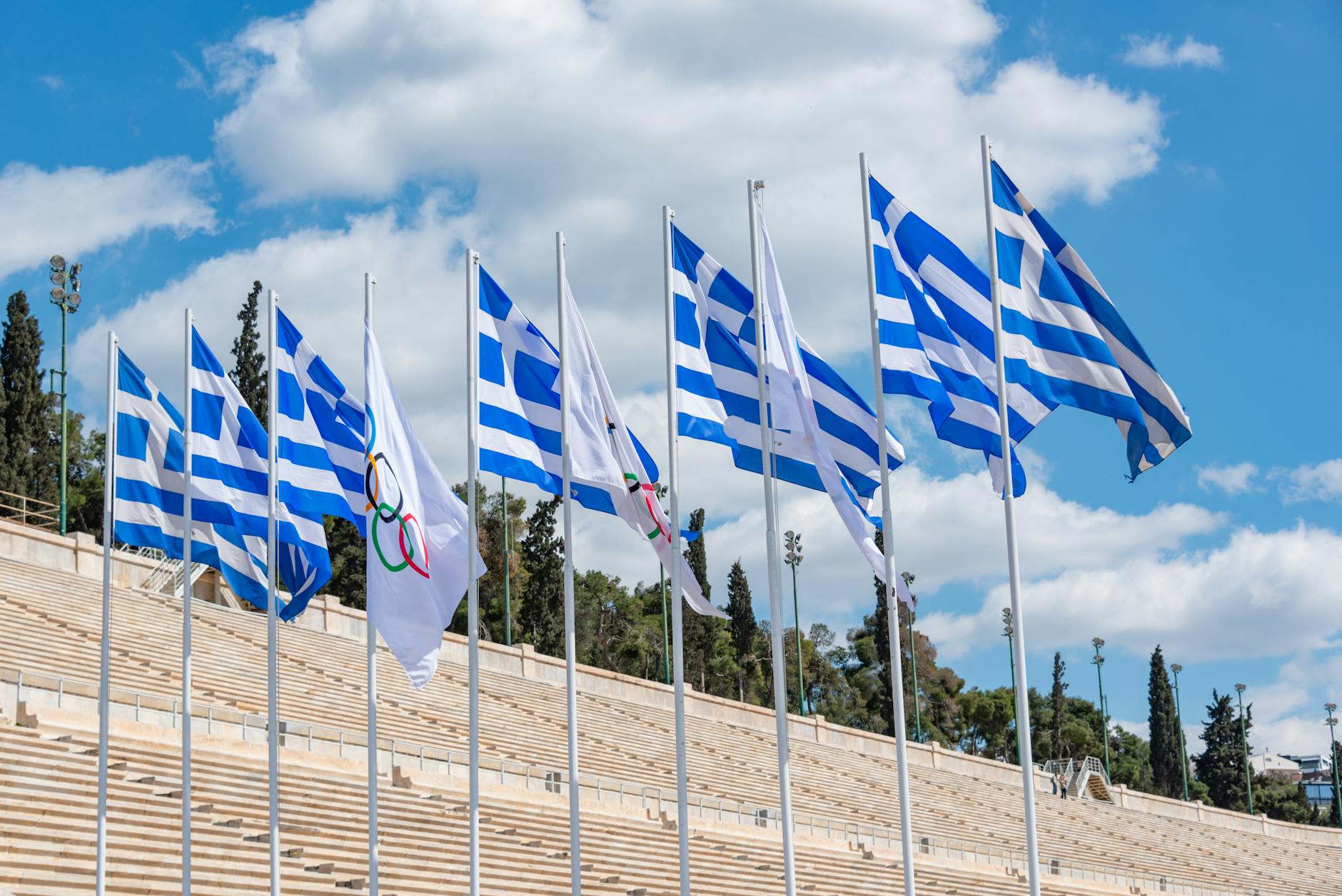
Picture the scene at Olympia in 700 BC. Thousands of spectators have traveled for days across sun-baked Greek terrain. The air smells of sacrificial smoke and olive oil. A group of athletes line up at the starting stone of the stadion track — a short, brutal foot race of roughly 200 meters. There is no clock. There is no official measuring the distance of a jump or calculating a personal best. When the race ends, one man raises his arms. He has won. That is the only number that matters: one.
For most of the ancient Olympic era, that was enough.
Victory as a Sacred Act, Not a Statistic
The ancient Games, which began in 776 BC and ran for over a thousand years, were not a sporting competition in the way modern Americans understand one. They were a religious festival dedicated to Zeus — king of the Olympian gods — and athletic performance was, at its core, an act of devotion. The goal was not to run a specific time. The goal was to be chosen. To be the man the gods favored on that particular day.
Winners received a simple crown of olive branches cut from a sacred tree near the Temple of Zeus. No gold medal. No prize money. No world record plaque. The glory was the prize, and that glory was immense. Victorious athletes returned home to cities that tore down their walls — symbolically declaring they needed no defense now that they had a champion among them. Poets like Pindar were commissioned to immortalize their names in verse. Statues were erected in their honor at Olympia itself.
In that world, asking "how fast did he run?" would have been a strange question. The answer everyone cared about was simpler: did he win, or didn't he?
The Absence of the Record — and Why It Didn't Matter
There were no official records kept from the ancient Olympics in any modern sense. Historians know the names of champions — Leonidas of Rhodes, who won twelve running events across four Olympic Games, is perhaps the most celebrated — but not their times, distances, or measurable outputs. The Greeks had no infrastructure for it. Standardized measurement tools barely existed. Water clocks, or clepsydrae, could track broad intervals of time but were nowhere near precise enough to differentiate athletic performance.
More importantly, the Greeks simply didn't think that way. Excellence — what they called arete — was a holistic concept. It encompassed strength, beauty, courage, and divine favor all at once. You couldn't reduce arete to a number. To try would have missed the point entirely.
This isn't to say Greek athletes were casual about performance. Training regimens at ancient Olympia were grueling, structured, and serious. Athletes spent months preparing under the supervision of coaches, following strict diets and practicing specific techniques. Competition was fierce. But the frame around that competition was symbolic rather than statistical.
The Moment Numbers Entered the Picture
The shift didn't happen overnight. As Greek culture gave way to Roman influence, and organized athletic competition slowly faded from its sacred roots, sport became more theatrical — gladiatorial spectacle rather than divine tribute. For centuries after the ancient Games were abolished in 393 AD, organized athletics largely disappeared from Western culture.
When sport re-emerged during Europe's Renaissance period, it came back wearing different clothes. Scientific thinking was reshaping how humans understood the world, and that mindset eventually reached athletics. By the 18th and 19th centuries, stopwatches were being used at horse races and foot races in England. Measurement became not just possible but fashionable.
The first modern Olympic Games in Athens in 1896 mark a clean dividing line. Those Games still carried the ceremonial weight of their Greek origins — the location was chosen deliberately, the olive branch tradition revived — but they introduced something the ancients never had: official results. Times were recorded. Distances were measured. The 1500m winner, Albin Lermusiaux, crossed the line in 4:33. That number was written down, published, and compared.
The record had been born.
What We Gained — and What We Let Go
The rise of measurable performance transformed athletics in ways that are almost impossible to overstate. It created a framework for progress. Runners could train toward a specific target. Coaches could identify weaknesses with precision. Across generations, athletes could compete against each other across time — a 2024 sprinter racing the ghost of a 1968 champion through the medium of a shared record.
American sports culture, in particular, embraced this model completely. The US sports landscape runs on statistics. Baseball analytics have their own dedicated industry. NFL passer ratings, NBA player efficiency scores, and Olympic split times are discussed with the seriousness of economic indicators. Numbers are how American fans understand greatness.
But something did get lost in that translation. The ancient Greek model asked a different question of its athletes — not "how fast?" but "who are you?" Victory was a statement about character, about the relationship between an individual and something larger than themselves. Modern sport, for all its precision, sometimes struggles to capture that dimension.
The greatest athletes today — the ones who transcend their statistics — still gesture toward it. When Simone Biles talks about competing for something beyond a score, or when marathon runners describe the spiritual dimension of finishing a grueling 26.2 miles, they're reaching for something the Greeks would have recognized immediately.
The Starting Line That Never Moved
Sport Origins exists because every record has a starting line. And the starting line for the modern obsession with athletic measurement runs directly through ancient Olympia — through a world where the only number that mattered was whether you were first or not.
Understanding that origin doesn't diminish modern sport. If anything, it deepens it. The next time you watch a world record fall on live television and feel that electric, almost irrational surge of emotion, consider that the Greeks would have understood exactly what you're feeling — even if they never would have understood the stopwatch that made it official.