The Soldier, the Myth, and the Marathon: Separating Fact From Legend in Sport's Greatest Origin Story
Every April, around half a million spectators line the streets of Boston to watch the world's oldest annual marathon. Runners from over 100 countries converge on Hopkinton, Massachusetts, for 26.2 miles of hills, heartbreak, and history. The race has become so embedded in American sporting culture that it's practically a civic holiday in New England.
And the whole thing was inspired by a story that almost certainly didn't happen the way you think it did.
The Legend Most Americans Know
Ask anyone on the street about the marathon's origin and you'll get some version of this: In 490 BC, a Greek messenger named Pheidippides ran approximately 25 miles from the battlefield at Marathon to Athens, burst through the city gates, gasped the word "Nike" (victory), and promptly collapsed and died. His heroic run became the inspiration for the marathon race, first introduced at the 1896 Athens Olympics.
It's a great story. Dramatic, clean, emotionally resonant. The problem is that it's a patchwork of different historical accounts stitched together over centuries, and the seams show when you look closely.
What the Historical Record Actually Says
The earliest account of the Battle of Marathon comes from Herodotus, the Greek historian writing roughly 40 years after the event. In his version, a runner named Pheidippides was sent not from Marathon to Athens, but from Athens to Sparta — a distance of roughly 150 miles — to request military assistance before the battle. He reportedly made the journey in two days, an extraordinary feat of ultramarathon-level endurance that gets almost no attention in popular culture.
The famous 25-mile run from Marathon to Athens? Herodotus doesn't mention it. At all.
The story of a messenger running from Marathon to Athens and dying upon arrival first appears in the work of Plutarch and Lucian, writing roughly 500 to 600 years after the battle. By that point, the story had already been filtered through generations of retelling, and the details vary between sources — the runner's name, the exact words spoken, and even the cause of death differ depending on which ancient writer you consult.
What historians are reasonably confident about is this: the Athenian army did march from Marathon to Athens after the battle — roughly 25 miles — and they did it quickly, in full military kit, to prevent a Persian naval force from attacking the undefended city. That forced march, completed by thousands of soldiers rather than one solitary runner, may be the actual historical event at the root of the marathon legend.
Pheidippides, if he existed as described, was likely a professional long-distance runner — a hemerodromos, or "day-runner" — whose real achievement was the Sparta mission, not the Marathon-to-Athens sprint. The two stories appear to have merged somewhere in the centuries between the battle and the Roman-era writers who popularized the dramatic death scene.
How a European Academic Revival Created an American Institution
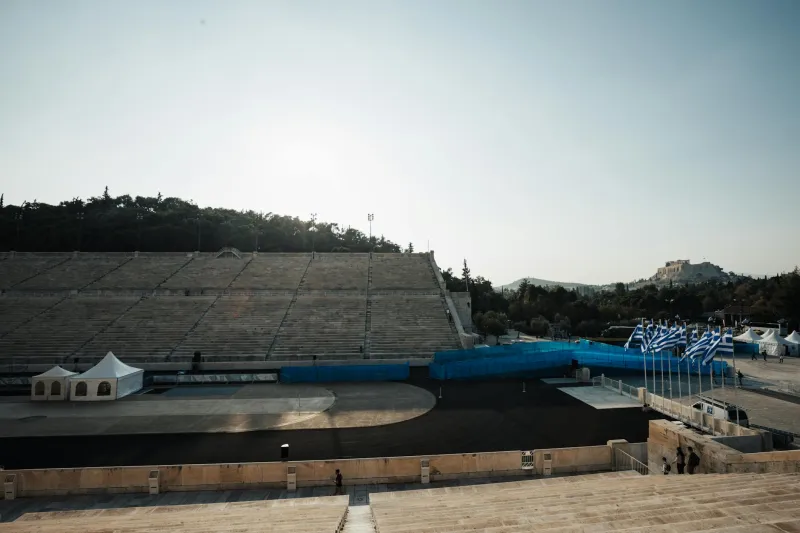
Fast forward to the 1890s. The push to revive the Olympic Games was gaining momentum, driven largely by French educator Pierre de Coubertin. As the organizing committee for the 1896 Athens Games took shape, a French linguist named Michel Bréal proposed something specific: a long-distance road race that would trace the route from Marathon to Athens, honoring the Greek warrior-messenger story and giving the Games a dramatic historical anchor.
The proposal was accepted. The marathon race was born — not from an unbroken ancient tradition, but from a 19th-century European intellectual's romantic interpretation of a fragmentary ancient legend.
The 1896 marathon was run over approximately 24.8 miles (the distance wasn't standardized at 26.2 miles until the 1908 London Olympics, and even that length has a convoluted origin story involving the British royal family). A Greek runner named Spyridon Louis won the race and became a national hero overnight — a moment of genuine athletic drama that helped cement the marathon's place in Olympic history.
A year later, in 1897, the Boston Athletic Association organized the first Boston Marathon, directly inspired by the Athens race. Fifteen men ran from Ashland to Boston on April 19, 1897. John J. McDermott of New York won in 2 hours, 55 minutes, and 10 seconds. The race has been held every year since, making it the world's oldest annual marathon — born from a legend that was itself born from a story that may have never happened quite as told.
Why Americans Adopted the Story So Completely
There's something worth examining in how deeply the marathon myth embedded itself in American sporting culture specifically. The United States doesn't have ancient athletic traditions of its own — no equivalent of Olympia, no millennia-old competitive festivals. American sport is young, pragmatic, and forward-looking.
But Americans are also drawn to origin myths. The country is built on founding stories — some accurate, some embellished, all emotionally powerful. The marathon offered something rare in American athletics: a story with genuine ancient roots, a hero who gave everything for a cause, and a tradition that connected modern competition to something thousands of years old.
The fact that the story was partly constructed, partly misremembered, and partly invented by 19th-century Europeans didn't diminish its power. If anything, it demonstrates how effectively sport can build meaning out of history — even imperfect history.
Today, the Boston Marathon draws over 30,000 official finishers annually. The New York City Marathon, Chicago Marathon, and dozens of other major American road races collectively see millions of participants every year. Distance running is one of the fastest-growing participation sports in the country.
The Real Legacy of Pheidippides
Whether or not a man named Pheidippides ran himself to death delivering news of a Greek military victory, the story he inspired created something real and enduring. The marathon has become one of sport's great democratic events — a competition where elite Kenyan and Ethiopian champions share a course with first-time recreational runners from suburban Ohio, all chasing the same finish line.
The ancient Greeks understood that sport needed narrative to matter — that athletic achievement gains power when it's connected to something larger than the competition itself. The marathon, built on a legend that was always more myth than history, proves that point better than almost any event in sport.
Every starting line has a story. Sometimes the story is messier than the legend. That doesn't make it any less worth running toward.