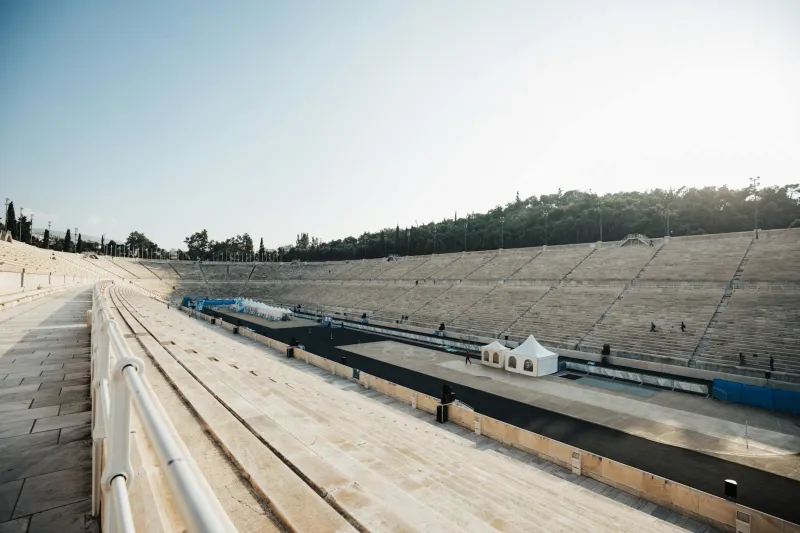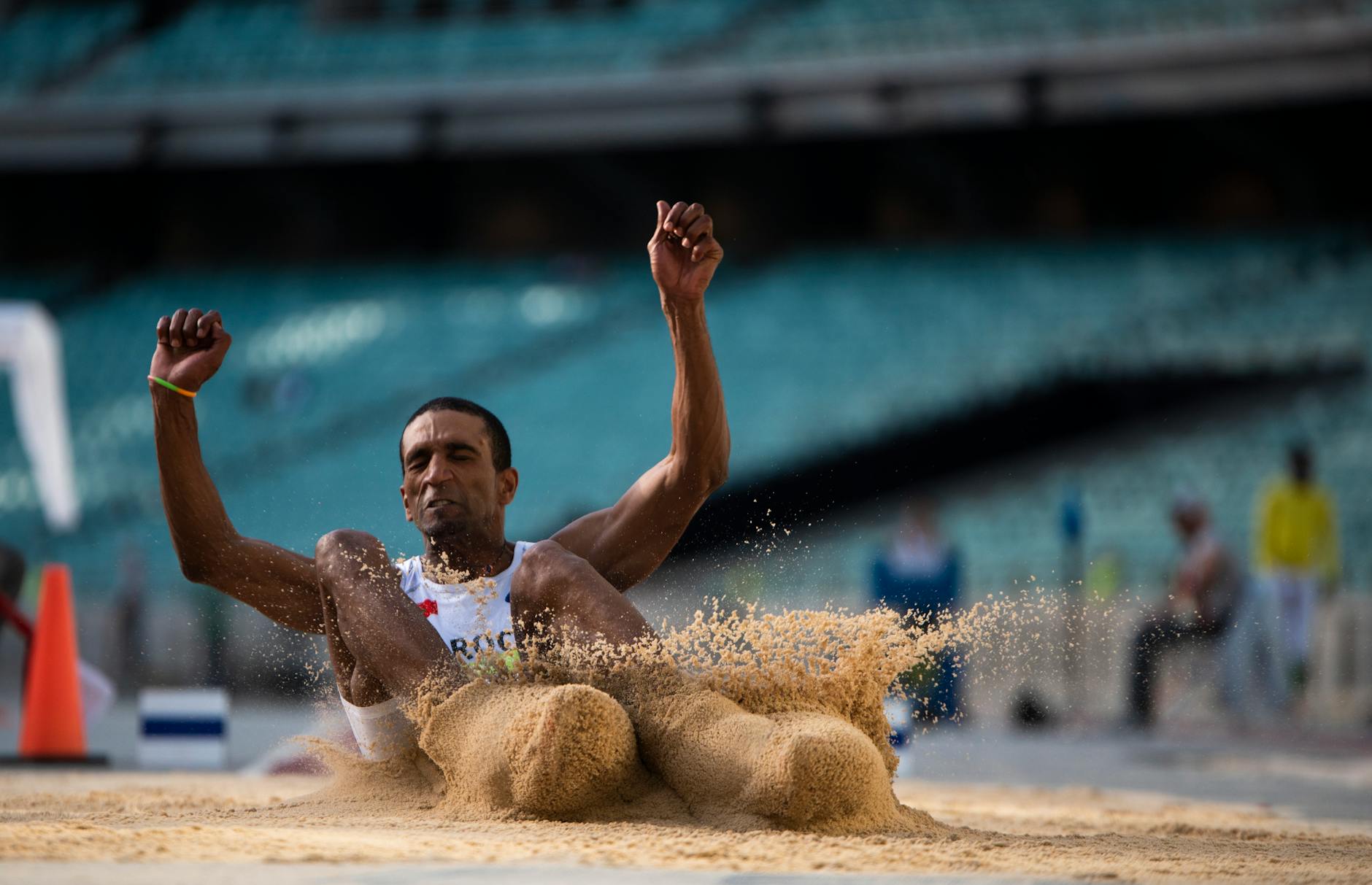
If you handed a modern Olympic long jumper a pair of stone weights and told them to use those to jump further, they'd probably look at you like you'd lost your mind. Dead weight in your hands while you're trying to fly through the air? That's not physics — that's punishment.
And yet, for centuries, that was exactly how the ancient Greeks did it. The long jump at the ancient Olympics — one of the five events in the prestigious pentathlon — required athletes to carry hand-held weights called halteres throughout the entire jump. Far from being a handicap, the Greeks believed these weights were the key to superior distance. They were, in a strange way, right — just not in the way you might think.
What the Ancient Long Jump Actually Looked Like
The ancient Greek long jump, or halma, bore only a passing resemblance to the event you'd watch at the US Olympic Trials today. Athletes began from a standing position — no running approach, no explosive sprint down a runway. They stood at the takeoff point, gripped their halteres (which could be made of stone, iron, or lead and weighed anywhere from two to ten pounds each), and launched themselves forward using a combination of leg drive and arm swing.
During the flight phase, athletes would swing the weights forward and then sharply back behind them at the moment of landing — a countermotion intended to drive the hips and feet further forward. Ancient sources, including the physician Galen, described this technique in enough detail that modern biomechanics researchers have been able to partially reconstruct it.
The landing itself was also judged differently. Athletes had to land cleanly, with no stumble or fall backward, or the jump didn't count. The sand pit — or skamma — had to show two clear, distinct footprints side by side. A messy landing was a failed jump, regardless of the distance covered.
Music was also part of the picture. Ancient accounts describe flute players performing during the long jump to help athletes establish rhythm during their approach and takeoff. The idea of synchronized athletic movement to music sounds more like a gymnastics floor routine than a field event — but the Greeks saw rhythm as fundamental to athletic excellence.
Did the Weights Actually Help?
This is where things get genuinely interesting, and where ancient intuition and modern sports science have a surprisingly productive conversation.
At first glance, adding weight to a jumping athlete seems counterproductive. More mass means more gravitational pull, which means less air time. Modern long jumpers go to extraordinary lengths to be as light and aerodynamically efficient as possible during their flight phase.
But biomechanics researchers who have studied the halteres technique — most notably a study conducted in the 1980s that tested the effect of weighted arm swings on jump distance — found something nuanced. The sharp backward swing of the weights at the point of landing does create a forward rotational momentum in the lower body, theoretically pushing the feet forward at the moment of impact. In other words, the weights didn't help athletes fly further — they helped athletes land further.
Whether this net benefit outweighed the cost of carrying extra weight through the air is still debated. But the Greeks weren't operating on superstition. They were working from careful observation of cause and effect, centuries before sports science existed as a discipline.
The Modern Long Jump: A Different Animal Entirely
The version of the long jump that American fans watch today is almost unrecognizable by comparison. Modern competitors sprint down a 130-foot runway at speeds approaching 25 miles per hour before launching off a takeoff board with explosive force. The flight phase involves sophisticated body positioning — the "hitch-kick" technique, where athletes cycle their legs in the air as if running, is designed to maintain forward momentum and prevent premature rotation that would cut the jump short.
The distances are staggering. Mike Powell's world record of 29 feet, 4.25 inches, set at the 1991 World Championships in Tokyo, has stood for over three decades. Bob Beamon's legendary 29-foot, 2.5-inch leap at the 1968 Mexico City Olympics — aided by high altitude and a favorable wind — was so far beyond anything previously achieved that the officials initially couldn't measure it with their optical equipment.
No ancient Greek competitor came close to those distances, but direct comparison is almost meaningless given how different the events were. The standing jump, even with halteres, operates under entirely different mechanical constraints than a sprint-launched modern jump. Some historians believe ancient Greek jumps may have been measured cumulatively across multiple attempts — a practice that would make the recorded distances in ancient texts make more sense, since some ancient accounts describe jumps that seem implausibly long for a standing start.
What Modern Coaches Are Quietly Borrowing
Here's where the story gets unexpectedly current. The ancient Greek insight about arm mechanics — that deliberate, forceful arm movement can influence jump distance and landing position — is very much alive in modern coaching. Elite long jump coaches today spend significant time working on arm drive during both the takeoff and the flight phase. The physics are the same ones the Greeks were intuitively working with: angular momentum generated in the upper body can transfer to the lower body in ways that affect the overall trajectory of a jump.
Some strength and conditioning coaches working with jumpers also use weighted implements during training drills — not during competition, but as a tool to develop the explosive arm-and-shoulder power that translates to better takeoff mechanics. The weights have moved from the competition to the weight room, but the underlying principle would have made sense to an ancient Greek trainer.
A 2,800-Year-Old Event That's Still Evolving
The long jump's journey from a standing, weighted, music-accompanied ritual at Olympia to a high-speed, precision-engineered modern field event is one of sport's most fascinating evolutionary arcs. It's a reminder that athletic events don't arrive fully formed — they develop, adapt, and sometimes transform so completely that only the name connects them to their origins.
The next time you watch a long jumper explode down the runway at a Diamond League meet or a college track and field championship, spare a thought for the Greek athlete standing at the skamma, weights in hand, waiting for the flute player to set the rhythm. He was solving the same problem — how to get a human body as far through the air as possible — with completely different tools. And some of what he figured out is still being used today.