The Champion Who Connected Two Worlds: Jim Thorpe's Olympic Legacy and America's Search for the Complete Athlete

The King of Sweden Knew Greatness When He Saw It
"You, sir, are the greatest athlete in the world," King Gustav V told Jim Thorpe as he placed gold medals around his neck at the 1912 Stockholm Olympics. Thorpe, with characteristic understatement, reportedly replied: "Thanks, King."
 Photo: 1912 Stockholm Olympics, via img.olympics.com
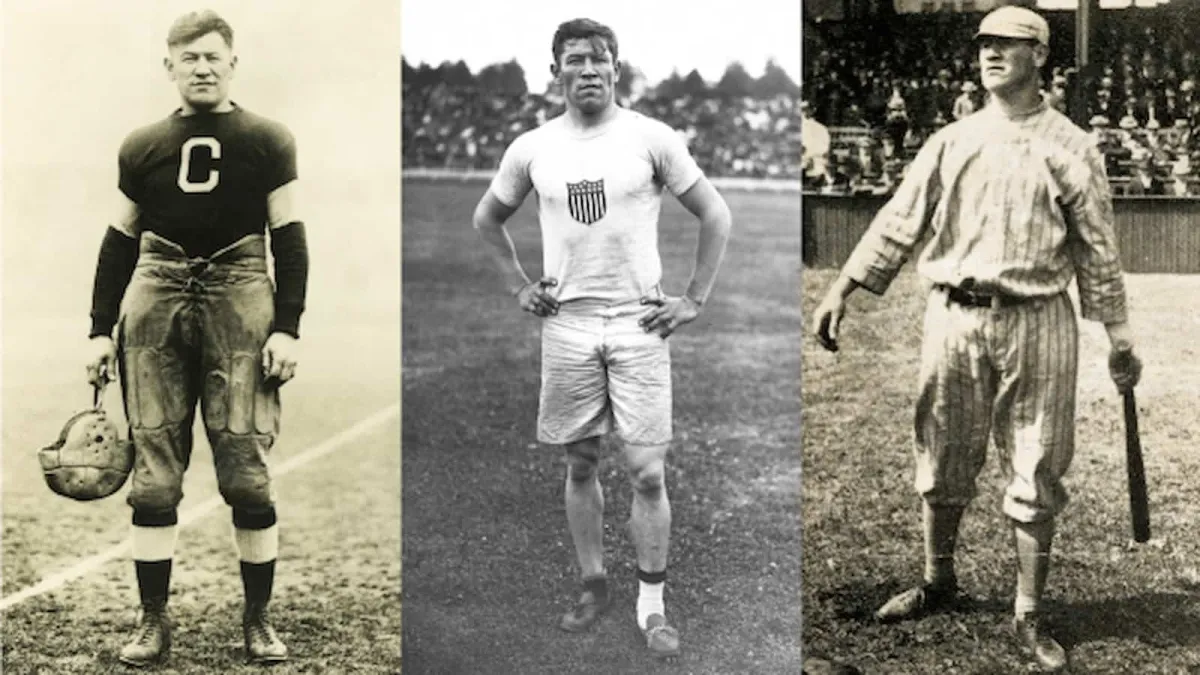 Photo: Jim Thorpe, via newsd.in
In that moment, an Oklahoma-born Native American had achieved something that connected directly to ancient Greek ideals of athletic perfection. Thorpe didn't just win—he obliterated the competition in both the pentathlon and decathlon, sports designed to crown the most complete athlete on earth.
But Thorpe's story reveals more than individual excellence. It illuminates America's complicated relationship with defining greatness, and how a nation built on ideals of fairness and opportunity has repeatedly struggled to live up to those principles when it comes to deciding who deserves to be called a champion.
Ancient Ideals Meet American Reality
The ancient Greeks created the pentathlon because they believed the greatest athletes should excel across multiple disciplines. A true champion wasn't just fast or strong—he was the complete package. When Baron Pierre de Coubertin revived the Olympics, he expanded this concept with the decathlon, calling its winner "the greatest athlete in the world."
Thorpe embodied this ideal perfectly. At the 1912 Olympics, he won the pentathlon by margins that seemed almost supernatural—finishing first in four of five events and second in the shot put. In the decathlon, his dominance was even more complete, setting a world record that would stand for nearly two decades.
His performance was so overwhelming that Hugo Wieslander, the Swedish athlete who finished second in the decathlon, refused to accept the gold medal when it was later offered to him. "Jim Thorpe was the greatest athlete in the world," Wieslander said. "He deserved those medals."
Yet within months, those medals would be stripped away, revealing the gap between American ideals and American practice.
The Price of Being Different
Thorpe's downfall came from a technicality that exposed the class-based hypocrisy of early 20th-century amateur athletics. In 1913, a newspaper revealed that Thorpe had been paid $25 per week to play minor league baseball during two summers in college. Under the strict amateur rules of the time, this made him a professional and retroactively disqualified him from Olympic competition.
The punishment was swift and merciless. The International Olympic Committee stripped Thorpe of his medals and erased his records from the books. His name disappeared from official Olympic history as if his dominance had never happened.
But the real story was more complex. The amateur rules that destroyed Thorpe's Olympic legacy were designed to keep working-class athletes out of elite competition. Wealthy college athletes could afford to train without pay; athletes like Thorpe, who came from poverty, often had to choose between athletic excellence and economic survival.
Thorpe's Native American heritage made him an even easier target. In 1912 America, a Native American claiming to be the world's greatest athlete challenged comfortable assumptions about racial hierarchy and American identity. Stripping his medals wasn't just about amateurism—it was about maintaining social order.
The Long Road to Justice
For decades, Thorpe's case became a symbol of how America's sporting establishment treated athletes who didn't fit the preferred mold. While his Olympic medals gathered dust in a Swiss vault, Thorpe continued competing professionally in football and baseball, proving his athletic genius across multiple sports well into his 40s.
The campaign to restore Thorpe's Olympic legacy lasted 70 years and involved everyone from Presidents to sports historians. The breakthrough came in the 1980s, when researchers discovered that the six-month statute of limitations for Olympic protests had expired just months after Thorpe's medals were stripped. The IOC had violated its own rules in punishing him.
In 1982, nearly three decades after Thorpe's death, the IOC finally restored his Olympic records and returned replica medals to his family. The ceremony was held at the Los Angeles Memorial Coliseum, with Thorpe's daughter accepting the honors her father had been denied for seven decades.
 Photo: Los Angeles Memorial Coliseum, via mir-s3-cdn-cf.behance.net
The Modern Legacy of the Complete Athlete
Thorpe's vindication marked more than personal justice—it represented America's evolving understanding of athletic greatness. His story helped establish the principle that excellence should be measured by performance, not background, and that the greatest athletes often come from unexpected places.
Today's American sports culture bears Thorpe's influence everywhere. The NFL Combine tests prospects across multiple athletic disciplines, echoing the Greek ideal of the complete athlete. College recruiting has become a national obsession precisely because Americans have learned that talent can emerge anywhere. The modern emphasis on athletic diversity—celebrating athletes from all backgrounds—traces directly to battles fought over cases like Thorpe's.
Consider modern multi-sport athletes like Bo Jackson or Deion Sanders, who achieved professional success across multiple disciplines. Their careers were possible because Thorpe helped establish that American athletics should celebrate versatility rather than punish it.
Why Thorpe's Story Still Matters
Every time an American athlete dominates international competition, they're walking in Thorpe's footsteps. When Kevin Durant leads Team USA to Olympic basketball gold, when Katie Ledecky breaks swimming world records, or when Ryan Crouser sets shot put marks, they benefit from a sporting culture that Thorpe helped create—one that measures greatness by achievement rather than pedigree.
Thorpe's legacy also serves as a reminder that American sports culture is constantly evolving. The same nation that stripped his medals eventually restored them. The same society that questioned whether a Native American could be the world's greatest athlete eventually built monuments to his memory.
The Eternal Champion
Jim Thorpe's 1912 Olympic performance lasted just two weeks, but its impact has endured for more than a century. He proved that American athletics could produce athletes who matched any standard of excellence, from any background, in any sport.
More importantly, his story demonstrates that true athletic greatness transcends the politics and prejudices of any particular era. The ancient Greeks understood this when they carved champions' names in stone. Thorpe's modern vindication proves the same principle: real excellence can't be erased, only temporarily hidden.
In connecting ancient ideals of the complete athlete with America's ongoing struggle to define fairness and opportunity, Thorpe became more than just a great competitor. He became a bridge between worlds, showing that the pursuit of athletic perfection is universal—and that America's greatest strength lies in embracing champions from everywhere.