Walk into any high school in America and you'll probably find a weight room. Rubber-coated plates. Power racks. Motivational posters on cinder block walls. It feels like a thoroughly modern institution — a product of sports science, suburban infrastructure, and the post-World War II fitness boom. But the idea behind it, the deliberate use of resistance to build a stronger human body, is older than the Roman Empire.
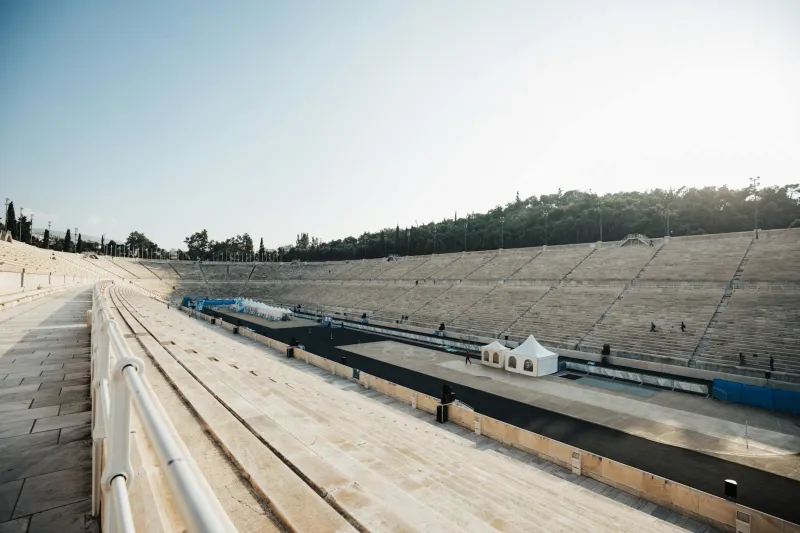
The history of strength training is one of the longest and least-told stories in American sports culture. And it starts not in a gym, but on the training grounds of ancient Greece.
The Greeks Figured It Out First
Ancient Greek athletes were not casually fit. The competitors who showed up at Olympia for the Games had trained systematically, often for years, under the supervision of coaches called paidotribes. The training methods they used were surprisingly sophisticated, and resistance work was central to them.
Archaeological evidence from ancient Greece includes stone blocks with handholds carved into them — essentially the world's first dumbbells. These halteres, as they were called, were used in the long jump event as handheld weights that athletes would swing forward during the leap to increase momentum. But they were also used in training as a form of resistance exercise, swung and lifted repeatedly to build strength and coordination.
Milo of Croton, the legendary wrestler who won six consecutive Olympic titles between roughly 540 and 516 BC, is often cited as the first documented practitioner of progressive overload — the principle that underlies modern strength training. According to ancient sources, Milo began carrying a newborn calf on his shoulders every day and continued doing so as the animal grew. By the time the calf had become a full-grown bull, Milo was carrying it with the same ease. The story may be embellished, but the principle it illustrates is entirely real: gradually increasing resistance over time produces greater strength. Every personal trainer in America is still teaching this concept today.
Greek wrestlers, discus throwers, and pankration fighters all engaged in what we would now recognize as strength and conditioning work. They lifted, they wrestled in sand pits for resistance, they carried heavy objects. They didn't have barbells, but they understood the fundamental mechanism.
The Long Gap and the Strongman Era
After the ancient Olympic Games were suppressed in 393 AD by the Roman Emperor Theodosius I, organized athletic culture in the Western world entered a long, fragmented period. Physical strength remained culturally valued — knights trained for combat, laborers developed functional strength through work — but the systematic, sports-science-oriented approach of the Greeks largely disappeared.
Strength as performance came roaring back in the 19th century in the form of strongman culture. Traveling showmen and circus performers across Europe and America built careers around feats of strength — lifting horses, bending iron bars, supporting platforms loaded with audience members. These acts were entertainment, but they also represented a serious physical subculture with its own competitive hierarchy.
The most famous strongman of the era was Eugen Sandow, a Prussian-born performer who toured the United States in the 1890s and became a genuine celebrity. Sandow was different from his predecessors because he was as interested in the aesthetics of the muscular body as he was in raw power. He gave public exhibitions, wrote training manuals, and opened physical culture studios in London. He's often credited as a founding figure of modern bodybuilding, but his influence on strength training more broadly was significant — he helped legitimize lifting as a pursuit for ordinary people, not just circus acts.
Around the same time, the first Olympic weightlifting events were contested at the 1896 Athens Games. Two events were held: a one-hand lift and a two-hand lift. The results were modest by modern standards, but the inclusion of weightlifting in the Olympic program was a turning point. It signaled that organized strength competition had a place in mainstream athletics.
Bob Hoffman and the American Barbell Revolution
If one figure can be credited with transforming strength training from a fringe pursuit into a cornerstone of American athletic preparation, it's Bob Hoffman. The York, Pennsylvania businessman founded the York Barbell Company in 1932 and spent the next four decades as the most influential figure in American weightlifting and physical culture.
Hoffman coached the US Olympic weightlifting team through much of the mid-20th century, producing multiple world and Olympic champions. But his impact extended far beyond competitive lifting. Through his magazine Strength & Health, which he launched in 1932, Hoffman reached hundreds of thousands of American readers with training advice, nutritional guidance, and the consistent message that lifting weights was not just for strongmen and Olympic athletes — it was for anyone who wanted to be physically capable.
His timing was fortunate. The post-World War II era saw a massive expansion of organized youth sports in the United States, and coaches across football, baseball, and track and field were increasingly open to the idea that their athletes could benefit from off-field strength work. Hoffman's equipment, his publications, and his network of advocates helped accelerate that shift.
By the 1960s and 1970s, resistance training had begun its migration into college athletic programs. Football programs at major universities started building dedicated weight facilities. The Dallas Cowboys, under coach Tom Landry, became one of the first NFL franchises to make systematic strength training a non-negotiable part of player development. The model spread rapidly.
From the Varsity Gym to Every High School in America
The explosion of weight rooms in American high schools is largely a story of the 1980s and 1990s. As sports medicine research began producing clearer evidence that strength training reduced injury risk and improved performance across virtually every sport, resistance work became standard rather than optional.
Title IX, passed in 1972, also played a role. As women's athletic programs expanded and female athletes began competing at higher levels, the benefits of strength training became relevant to a far broader population. The weight room, which had been an almost exclusively male space, gradually opened up — and the culture of athletic preparation in American schools shifted permanently.
Today, the National Strength and Conditioning Association estimates that organized strength and conditioning programs exist in the vast majority of US high school athletic departments. The equipment is more sophisticated, the coaching is more credentialed, and the science behind programming is more refined than anything Milo of Croton ever had access to.
But the principle is the same one the Greeks figured out two thousand years ago: make the body work against resistance, increase that resistance over time, and the body will adapt. The starting line for everything happening in American weight rooms today was drawn a very long time ago.