There is no moment in sports quite like the start of an Olympic 100-meter final. The stadium goes quiet. Eight of the fastest humans alive crouch into their blocks. Then the gun fires, and in roughly ten seconds, the whole thing is over — and the crowd absolutely loses its mind.
But here's something worth sitting with: that race, that electric, borderline-violent burst of human speed, didn't come from nowhere. It has a starting line that goes back almost 3,000 years, to a sun-scorched sanctuary in ancient Greece where athletes competed not for medals or endorsement deals, but for a wreath of olive branches and the favor of Zeus himself.
This is the story of how the world's most watched race got here.
The Stadion: Where It All Began
The earliest Olympic Games on record were held in 776 BC at Olympia, a religious site in the western Peloponnese region of Greece. The Greeks weren't just building a sports competition — they were staging a sacred festival, and the centerpiece was a single footrace called the stadion.
The stadion covered roughly 192 meters, the length of the stadium floor at Olympia, and it was the only event at those first Games. The winner, a cook named Coroebus of Elis, became the first recorded Olympic champion in history. No stopwatch. No photo finish. Just a man running as fast as his legs could carry him across a packed-earth track while thousands of spectators roared from the surrounding hillsides.
Estimates suggest those ancient sprinters were finishing their races in somewhere around 12 to 13 seconds for a comparable distance — respectable, but nowhere near what was coming.
1896 and the Birth of the Modern Sprint
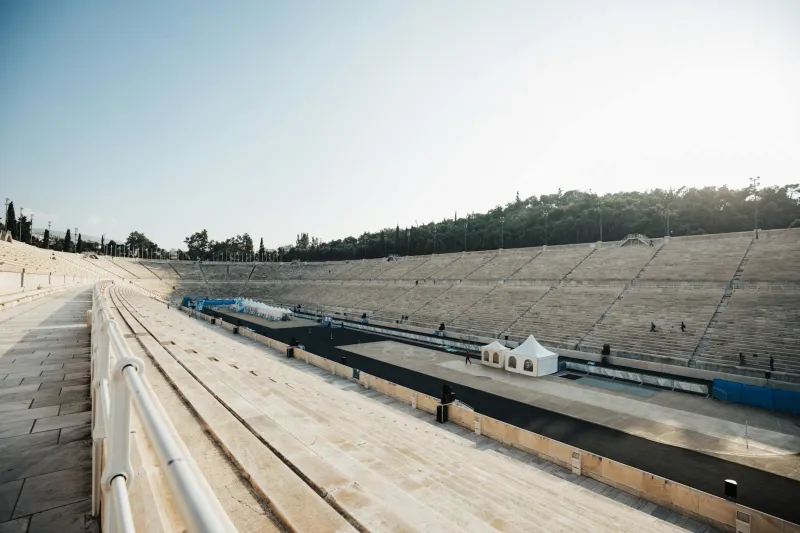
Fast forward roughly 2,600 years. The modern Olympic Games were revived in Athens in 1896, and the 100-meter dash was right there at the center of the track and field program. American sprinter Thomas Burke crouched into a distinctive upright starting position that puzzled European competitors and won the gold medal in 12.0 seconds.
Twelve seconds. On a cinder track. In leather shoes. That time would have been competitive with a Greek stadion runner — and it marked the new starting line for everything that followed.
The surface Burke ran on was a far cry from what today's sprinters use, but it was already an improvement over bare earth. Cinder tracks, made from compressed ash and gravel, became the standard for decades. They were faster than dirt, but they were also unpredictable — affected by rain, wind, and uneven packing. Breaking a world record on a bad-weather day was basically impossible.
Jesse Owens and the Moment America Announced Itself
If one athlete defined the sprint's rise as a cultural phenomenon, it was Jesse Owens. At the 1936 Berlin Olympics — staged under the shadow of Nazi ideology — Owens, a Black man from Alabama, won four gold medals and ran the 100 meters in 10.3 seconds. In front of Adolf Hitler. On German soil.
It wasn't just fast. It was a statement.
Owens had grown up running on grass and cinder tracks in Ohio, trained by legendary coach Charles Riley, and he brought a combination of natural talent and disciplined technique that was ahead of its time. His performance didn't just shatter records — it helped cement the United States as the dominant force in sprint history, a reputation American athletes have spent nearly a century defending and extending.
The Technology Revolution: Tracks, Blocks, and Spikes
Here's where things get genuinely fascinating from a sports science perspective. The drop from 12 seconds to under 10 didn't happen because humans suddenly evolved. It happened because everything around the athlete changed.
Track surfaces made a massive leap in the late 1960s when synthetic polyurethane tracks — the kind you see at every major stadium today — replaced cinder. These surfaces return more energy to the runner with each stride, essentially giving a small mechanical assist that cinder never could. Studies have estimated that modern track surfaces alone account for improvements of roughly 0.1 to 0.2 seconds compared to cinder.
Starting blocks, which became standard in the 1940s, gave sprinters a rigid platform to push against at the gun. Before blocks, runners dug small holes in the track with a trowel. The difference in explosive force transfer is enormous.
Spike technology evolved from basic leather shoes with crude metal spikes to ultra-lightweight carbon-fiber plates and precision-engineered spike placement designed to maximize propulsion and minimize ground contact time. Nike's Zoom and Adidas's sprint spikes today are essentially racing machines built around a human foot.
And then there's sports science — nutrition, biomechanical analysis, altitude training, and recovery protocols that would have sounded like science fiction to Thomas Burke in 1896.
Florence Griffith-Joyner: The Record That Still Stands
No conversation about sprint history is complete without FloJo. Florence Griffith-Joyner ran 10.49 seconds in the 100 meters at the 1988 US Olympic Trials — a world record that has stood for over 35 years and counting. With her signature long nails, one-legged running suits, and an almost violent acceleration off the line, she didn't just break the record. She redefined what a sprinter could look like.
Flo-Jo's legacy runs deep in American athletics. She proved that speed could be theatrical, personal, and culturally resonant — that a sprinter wasn't just an athlete but a personality, a story, a moment.
Bolt and the Edge of Human Possibility
Then came Usain Bolt. At the 2009 World Championships in Berlin — the same city where Jesse Owens had stunned the world 73 years earlier — the Jamaican sprinter crossed the finish line in 9.58 seconds, the current world record. He was so far ahead of the field that he had time to glance sideways before the race was over.
Bolt's combination of extraordinary stride length (he covers roughly 2.5 meters per stride at full speed) and a biomechanical profile that shouldn't theoretically work for a 6-foot-5 sprinter made him an anomaly. Sports scientists are still studying exactly how he did what he did.
From Coroebus running barefoot on packed earth in 776 BC to Bolt gliding across a polymer track in Berlin — the race is the same in spirit, completely transformed in execution.
Why the Starting Line Still Matters
Every time the blocks are set for an Olympic 100-meter final, that 3,000-year thread pulls taut. The event has absorbed ancient ritual, Cold War politics, civil rights symbolism, and the relentless march of human ingenuity. It is, in every sense, where sport began — and where it keeps reinventing itself.
The next world record is already being trained for somewhere. And when it falls, it will carry the weight of every race that came before it.