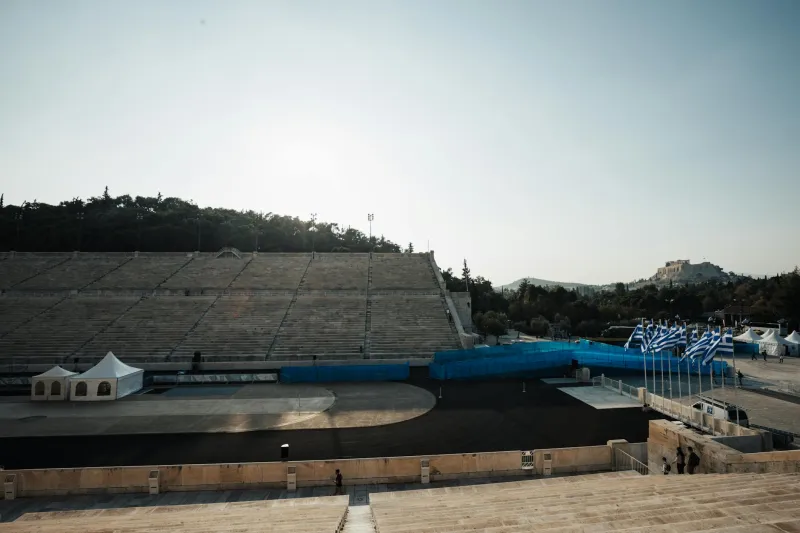
The Race That Started Everything
In 776 BC, on a dusty strip of land in ancient Olympia, Greece, a single runner named Coroebus crossed a finish line and became the first recorded Olympic champion in history. His victory wasn't in the marathon, the discus, or any of the elaborate multi-event competitions we associate with ancient athletics. Instead, Coroebus won the stadion—a straight-line sprint covering roughly 200 meters that would become the genetic code for every timed footrace in American sports.
The stadion wasn't just the inaugural Olympic event; it was the only event for the first 13 Olympic Games. For over 50 years, this single race defined what it meant to be the world's fastest human. Today, that same obsession with pure speed drives everything from NFL draft evaluations to high school track championships across America.
The Sacred Science of Starting
What made the stadion revolutionary wasn't its distance—it was its format. Greek athletes lined up shoulder to shoulder at a marble starting line called the balbis, with grooves carved for their toes. They waited for the starter's signal, then exploded forward in a straight line toward a single finish point. Sound familiar?
This exact setup appears every Friday night at American high school tracks, every spring at college invitationals, and every February at the NFL Scouting Combine in Indianapolis. The forty-yard dash that determines draft positions and scholarship offers follows the same principles Coroebus used nearly three millennia ago: line up, wait for the signal, run straight, and let pure speed decide the winner.
The Greeks understood something fundamental about human competition that Americans have embraced completely—speed is the most honest measurement of athletic ability. You can't fake it, you can't strategize around it, and you can't hide from it. Either you're fast or you're not.
From Olympia to America's Obsession
The stadion's influence on American athletics goes far beyond track and field. When football coaches time prospects in the forty-yard dash, they're using the same winner-takes-all mentality that crowned ancient Olympic champions. When basketball players run suicide sprints in practice, they're following the Greek belief that speed translates to success in all athletic endeavors.
Consider the numbers: the average winning time for the stadion was roughly 24 seconds for 200 meters. That's significantly slower than modern high school athletes, who regularly break 22 seconds for the same distance. But the gap reveals something remarkable about athletic evolution—while techniques, training, and equipment have transformed performance, the fundamental competition remains unchanged.
American sprinters like Carl Lewis, Michael Johnson, and Noah Lyles are essentially running the same race as Coroebus, just with better spikes and more precise timing. The starting blocks used at the U.S. Olympic Trials serve the same purpose as those ancient toe grooves in Olympia—to give every athlete an equal start in the pursuit of pure speed.
The DNA of American Competition
The stadion established three principles that define American sprint culture today: standardized starts, straight-line courses, and objective measurement. Every high school in America uses these same fundamentals because they create the fairest possible competition.
When a high school sophomore steps into the blocks for her first 100-meter race, she's participating in an unbroken chain of competition that stretches back to ancient Greece. The nervous energy before the starter's pistol, the explosive drive off the line, and the desperate lean at the finish—these moments connect modern American athletes to their ancient predecessors in ways they might never realize.
The forty-yard dash has become America's unofficial measurement of athletic potential precisely because it captures the essence of the stadion: pure, undiluted speed over a short distance. NFL scouts don't time players in the 400 meters or the mile—they want to see that explosive burst that separated Olympic champions from ordinary mortals in ancient Greece.
Speed as the Universal Language
What makes the stadion's legacy so powerful in American sports is its simplicity. Unlike complex team strategies or subjective judging, sprint races produce clear winners and undeniable results. This appeals to the American competitive spirit in the same way it appealed to ancient Greek spectators.
The Greeks believed speed was a gift from the gods, a divine blessing that elevated certain humans above others. Americans have secularized this belief but maintained its core—we still view exceptional speed as something special, something that can't be taught or manufactured, only discovered and refined.
The Eternal Sprint
Every spring, when millions of American students line up for their first track practice, they're answering the same call that brought Coroebus to Olympia 2,800 years ago. The desire to prove who's fastest, who can cover ground most efficiently, who possesses that rare gift of speed—these motivations transcend time and culture.
The stadion may have lasted only 24 seconds, but its impact on American athletics has endured for millennia. From the sacred grove of Olympia to the synthetic tracks of American high schools, the race remains fundamentally the same: line up, run straight, and let speed tell the truth.
In a world of complex analytics and advanced training methods, there's something refreshingly honest about the sprint. Like its ancient predecessor, it strips away everything except the most basic question in athletics: who's fastest? The answer, whether delivered on ancient Greek soil or modern American tracks, still determines champions.