
The Fastest Human Who Never Wore Shoes
Picture this: It's 164 AD in ancient Olympia. The crowd roars as a young athlete named Leonidas of Rhodes explodes from the starting line, his bare feet pounding against packed earth and sand. No starting blocks. No synthetic track. No $300 carbon-plated racing spikes. Just raw human speed meeting the ground that Zeus himself was said to have blessed.
Leonidas won 12 Olympic crowns across four different Games—a record that stood for over 2,000 years until Michael Phelps finally broke it in 2016. He did it all without a single piece of modern technology touching his feet.
That achievement raises a question that's been haunting athletics ever since Nike's Vaporfly shoes started obliterating marathon records: How much of human speed comes from the human, and how much comes from what's strapped to their feet?
When Feet Met Earth
Ancient Greek athletes didn't choose to compete barefoot—they had no choice. The concept of specialized athletic footwear simply didn't exist. Everyday sandals were made from leather or woven plant fibers, designed for walking on stone streets, not sprinting for Olympic glory.
But here's the remarkable thing: they were incredibly fast anyway.
While we can't know exact times from ancient competitions (they measured success by placement, not stopwatches), modern analysis of ancient athletic achievements suggests these barefoot warriors were operating at levels that would shock today's sports scientists. Archaeological evidence from ancient stadiums shows track surfaces that were meticulously maintained—hard-packed earth mixed with sand for optimal traction and speed.
Some historians estimate that elite ancient sprinters could complete the stadion (roughly 200 meters) in times that would translate to sub-22-second 200-meter performances today. Consider that the current high school national record in America is 20.13 seconds—achieved by athletes wearing cutting-edge spikes on synthetic tracks.
The Leather Revolution
The first major leap in athletic footwear came not from athletes, but from soldiers. Roman legionnaires developed the caliga—a heavy-duty leather boot with hobnails for traction. While never intended for sport, these boots introduced two concepts that would eventually revolutionize running: foot protection and mechanical grip.
By the medieval period, European athletes competing in early track and field events began experimenting with modified leather shoes. These weren't purpose-built racing spikes, but craftsmen started adding metal studs or even nails to regular shoes for better traction on grass fields.
The real breakthrough came in 1852 when British runner John Smith commissioned a cobbler to create shoes specifically for racing. These featured leather uppers, thin soles, and the first primitive spikes—metal points driven through the sole for traction. Smith's times immediately improved, and the athletic footwear arms race officially began.
America Joins the Race
American innovation entered the picture in the 1890s when the Spalding company started mass-producing spiked running shoes. These early American designs prioritized durability and comfort over pure speed—reflecting the American approach to athletics that emphasized broader participation rather than just elite performance.
The 1936 Olympics in Berlin marked a turning point. Jesse Owens dominated the track wearing handcrafted leather spikes made by a young German cobbler named Adolf "Adi" Dassler—who would later found Adidas. Owens' four gold medals weren't just a triumph over Nazi ideology; they were a demonstration of how proper footwear could amplify human potential.
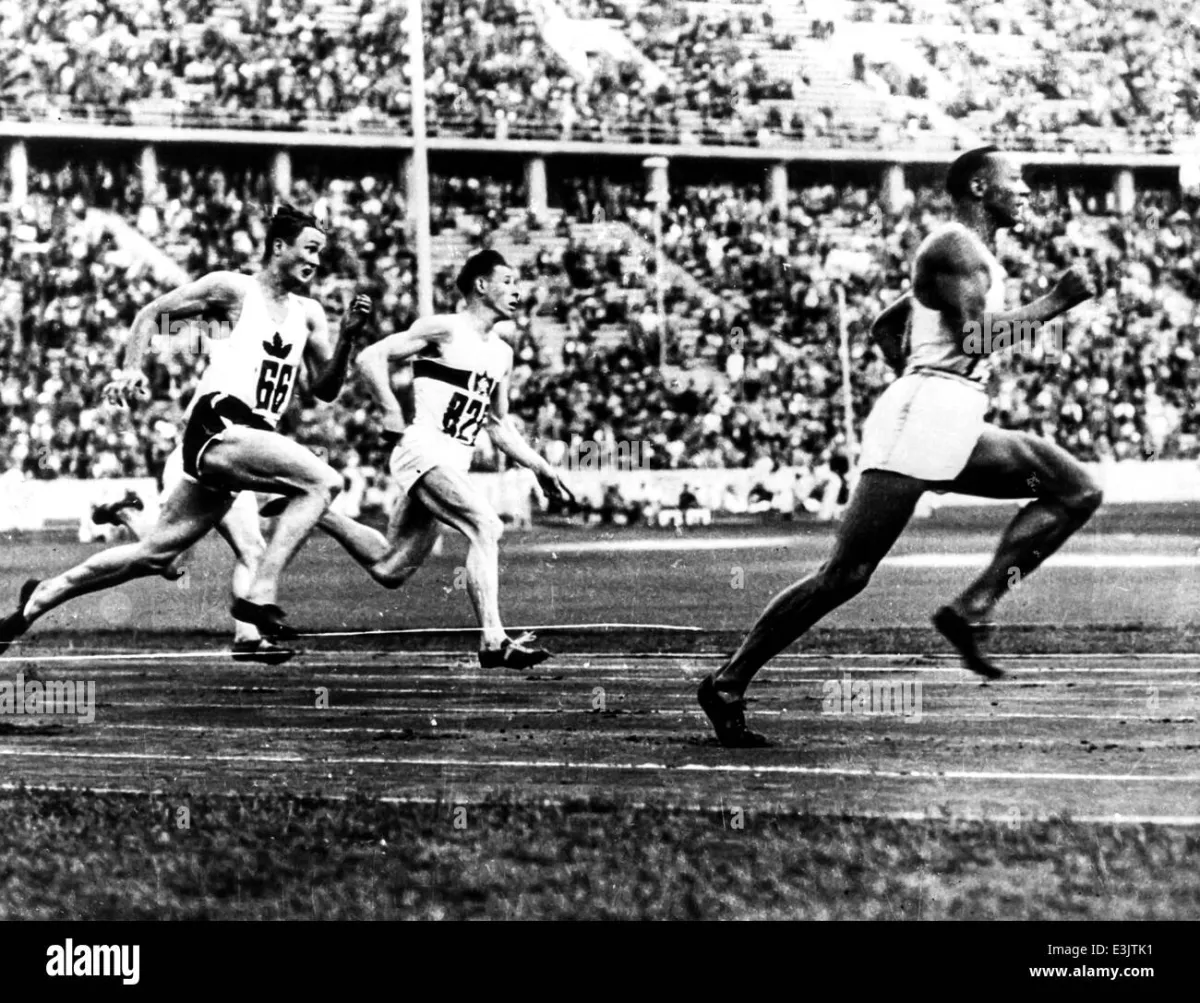 Photo: Jesse Owens, via c8.alamy.com
Post-World War II, American companies like Nike (founded in 1964) and New Balance began applying space-age materials and sports science to shoe design. The introduction of synthetic materials, air cushioning, and computer-designed sole patterns gradually transformed running shoes from simple foot protection into sophisticated performance machines.
The Supershoe Controversy
Then came 2016, and everything changed.
Nike's Vaporfly shoes, featuring carbon-fiber plates embedded in ultra-thick foam soles, began producing results that defied athletic logic. Marathon times that had been stagnant for decades suddenly plummeted. Eliud Kipchoge ran the first sub-2-hour marathon (though not in official competition) wearing an even more advanced version.
 Photo: Eliud Kipchoge, via www.runblogrun.com
The numbers are staggering: studies suggest these shoes can improve running efficiency by 4-6%. In marathon terms, that translates to roughly 3-5 minutes for elite athletes—the difference between making an Olympic team and watching from home.
Critics argue we're witnessing technological doping. When Kipchoge broke the official marathon world record in Berlin wearing Vaporflys, some pointed out that his shoes cost more than many runners' monthly salaries and contained more advanced engineering than some spacecraft.
The Asterisk Question
This brings us to the uncomfortable question that ancient Greek athletes never had to face: When does equipment enhancement cross the line from legitimate innovation to unfair advantage?
Track and field's governing bodies have struggled with this balance. They've banned some extreme shoe designs while allowing others, creating a confusing landscape where success increasingly depends on access to the latest technology.
Compare this to those ancient Greek champions who achieved immortality with nothing but their natural speed and the dirt beneath their feet. Leonidas of Rhodes never worried about whether his equipment gave him an unfair advantage—because he had no equipment.
What the Future Holds
Today's athletic footwear continues evolving at breakneck speed. Companies are experimenting with 3D-printed midsoles, AI-designed traction patterns, and materials borrowed from Formula 1 racing. Some prototypes feature real-time biomechanical feedback and adaptive cushioning that changes based on running conditions.
But perhaps the most important lesson from this 3,000-year journey isn't about the shoes at all. It's about human adaptability. Ancient athletes maximized their potential within their technological constraints, just as modern athletes push boundaries within theirs.
Whether barefoot on ancient dirt or carbon-plated on modern tracks, the fundamental drive to run faster than anyone has run before remains unchanged. The shoes may have evolved, but the human spirit that powered Leonidas of Rhodes through 12 Olympic victories is the same force that drives today's athletes to chase seemingly impossible times.
The starting line may look different now, but the finish line still rewards the same thing it did 3,000 years ago: the athlete willing to push furthest beyond what anyone thought possible.