When Americans tune in to watch a high school state wrestling championship, or lose their minds over a 40-yard dash time at the NFL Combine, they're not usually thinking about ancient Greece. Why would they be?
But here's the thing: the athletic DNA of those moments traces directly back to the Olympic Games at Olympia, where Greek competitors were testing the exact same fundamental skills — strength, speed, throwing distance, jumping power — more than 2,500 years ago. The equipment changed. The rules evolved. The stadiums got a little bigger. But the basic human contest? Remarkably intact.
Here are five ancient Greek Olympic sports that are quietly running the show in American athletics today.
1. Wrestling (Pale): The Oldest Sport in Every High School Gym
The Ancient Version
Wrestling was one of the most prestigious events at the ancient Olympics, introduced to the Games in 708 BC. The Greeks called it pale, and it was contested on a sand-covered floor in a space called the palaistra — essentially the world's first wrestling room. The objective was to throw your opponent to the ground three times. No rounds, no time limits, no weight classes. Just two men grappling until someone hit the dirt.
The legendary wrestler Milo of Croton won the Olympic wrestling title six times between 540 and 516 BC — a dynasty that wouldn't look out of place in the modern NCAA record books. He reportedly trained by carrying a growing calf on his shoulders every day until it became a full-grown bull. Ancient progressive overload.
The American Connection
Wrestling is one of the most widely participated high school sports in the United States, with hundreds of thousands of student athletes competing across the country every season. The NCAA wrestling program, the Olympic freestyle and Greco-Roman disciplines, and even the explosive growth of submission grappling in the MMA era all trace their competitive logic back to pale.
The core hasn't changed: control your opponent, take them down, establish dominance. Milo of Croton would recognize the game immediately.
2. The Long Jump (Halma): From Olympia to the Olympic Trials
The Ancient Version
The ancient long jump, called halma, was part of the pentathlon — a five-event combination that the Greeks considered the ultimate test of a complete athlete. But it came with a twist that modern jumpers don't deal with: competitors carried hand weights called halteres, typically made of stone or lead, and swung them forward at takeoff to generate extra momentum.
There are ancient records suggesting jumps of over 50 feet, which has led to significant historical debate — some scholars believe those figures represent a series of jumps rather than a single leap. Either way, the Greeks took the event seriously enough to build it into their most prestigious multi-event competition.
The American Connection
The long jump has been a cornerstone of American track and field for well over a century. Jesse Owens set a world record of 26 feet 5.25 inches at the 1935 Big Ten Championships that stood for 25 years. Bob Beamon's 29-foot-2.5-inch leap at the 1968 Mexico City Olympics was so far beyond the existing record that the measuring equipment couldn't reach it on the first attempt.
Today, the long jump remains a marquee event at the US Olympic Trials, and American athletes have consistently ranked among the world's best. The halma pit has just gotten a lot more precisely measured.
3. The Javelin (Akon): Throwing Culture from Ancient Greece to the Backyard of Every Track Program
The Ancient Version
The javelin throw, known in ancient Greek as the akon, was another pillar of the pentathlon at Olympia. Greek athletes used a leather finger loop called an ankyle wrapped around the shaft to generate spin and increase distance — a technique that functioned similarly to the rifling in a gun barrel, stabilizing the javelin's flight path.
This wasn't just an athletic contest. Javelin throwing was a fundamental military skill in ancient Greek society. The same mechanics that won at Olympia kept soldiers alive in battle. Training for sport and training for war were essentially the same thing.
The American Connection
Javelin is a standard event in virtually every US high school and college track and field program. It's also one of the decathlon's ten disciplines — and the decathlon, introduced at the modern Olympics in 1912, is widely considered the ultimate test of all-around athletic ability, a direct philosophical descendant of the ancient Greek pentathlon.
The finger-loop technique is gone, replaced by a precise grip and release system refined over decades of biomechanical research. But the fundamental challenge — throw a spear as far as humanly possible — hasn't changed since 708 BC.
4. The Discus (Diskos): Art, Physics, and the Most Iconic Image in Sports History
The Ancient Version
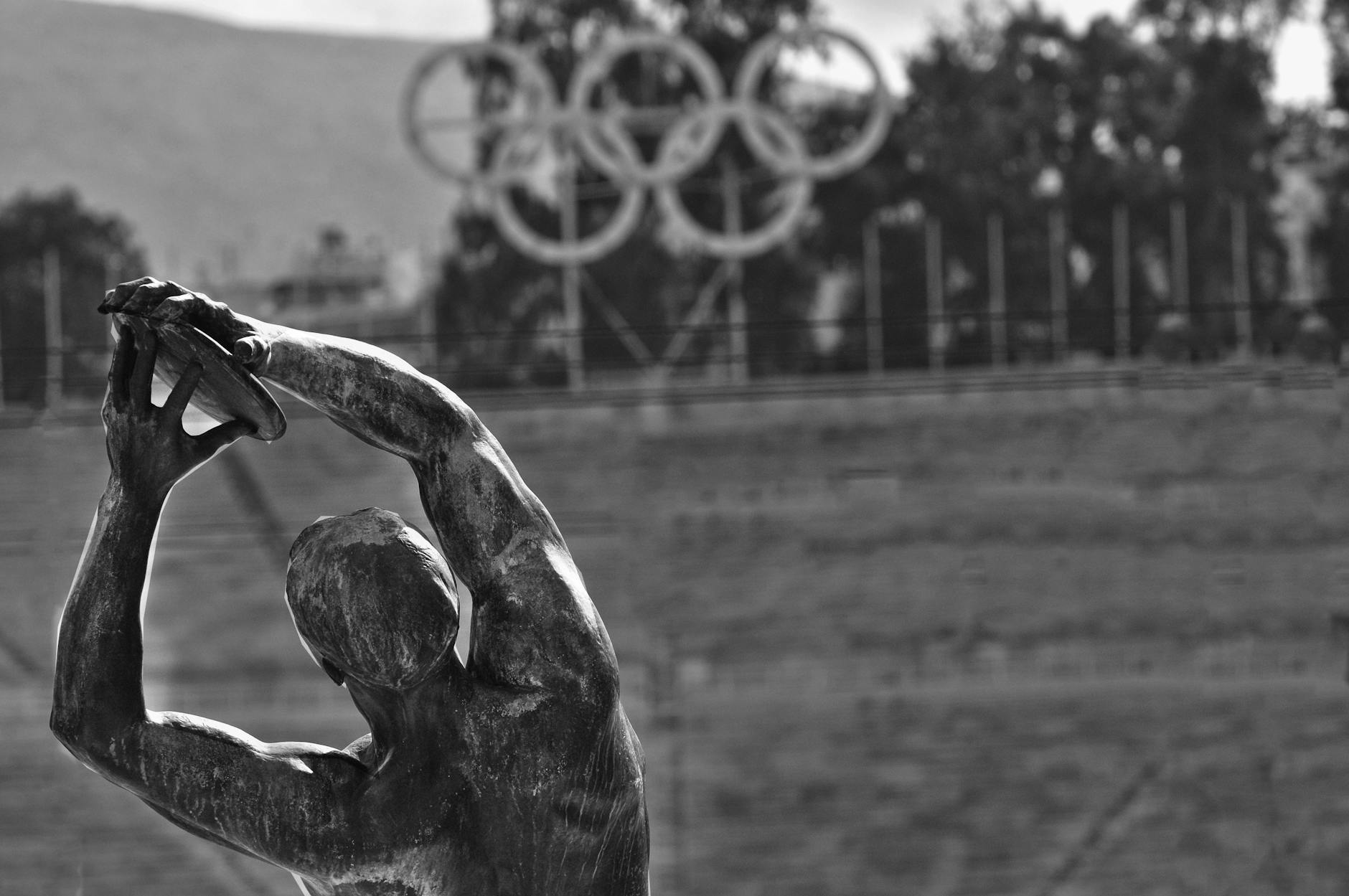
Few images from ancient athletics are more recognizable than the Discobolus — the famous Greek sculpture of a discus thrower frozen mid-rotation, muscles coiled, ready to release. It was created around 450 BC by sculptor Myron and has become one of the most reproduced works of art in history. The discus event (diskos) was contested at Olympia using a heavy stone or bronze disc, and technique was everything: rotation, timing, release angle.
The Greeks understood the physics intuitively even without the vocabulary for it. They knew that a flat, spinning object released at the right angle traveled farther than one thrown straight. That's aerodynamics, figured out on a sand track in ancient Greece.
The American Connection
Discus is a staple of American track and field at every level. Al Oerter won four consecutive Olympic gold medals in the discus from 1956 to 1968 — a feat of consistency that remains one of the most remarkable in Olympic history. The event sits comfortably in every college conference championship and is a fixture of the high school throwing circuit across the Midwest and South, where big-bodied athletes with rotational power have been cultivated for generations.
The Discobolus is still the unofficial mascot of the whole discipline. Some things just don't need updating.
5. The Stadion Footrace: The Direct Ancestor of Every Sprint in America
The Ancient Version
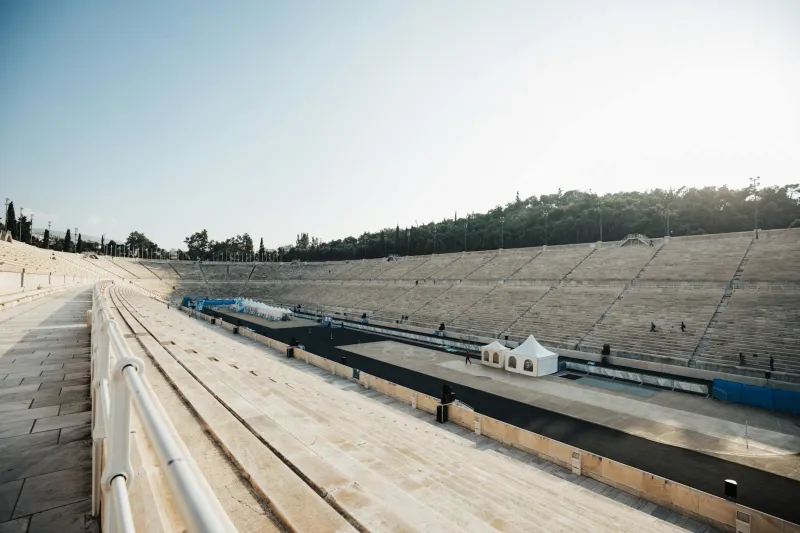
The stadion was the original Olympic event — a straight sprint of roughly 192 meters down the length of the stadium floor at Olympia. It was the only event at the first recorded Olympic Games in 776 BC, and for a long time, it remained the most prestigious. The winner didn't just get a wreath — the Olympiad itself was named after them. That's how central the footrace was to Greek athletic culture.
Runners competed barefoot on packed earth, exploding from a standing start at the sound of a trumpet. No blocks, no synthetic surface, no spike technology. Pure, unassisted human speed.
The American Connection
The sprint is the backbone of American track culture. From the 40-yard dash at the NFL Combine — where a tenth of a second can shift a player's draft stock by millions of dollars — to the 100-meter final at the US Olympic Trials, raw sprinting speed is arguably the most valued athletic commodity in American sports. Football, basketball, baseball, soccer: every major American team sport is, at its core, a competition between athletes who can accelerate and reach top speed faster than their opponents.
The ancient Greeks built their entire athletic festival around a footrace. Americans built an entire sports economy around the same idea. The stadion never really ended — it just moved to a bigger venue.
The Deeper Game
What's remarkable about this list isn't just that these events survived — it's that they thrived, adapted, and embedded themselves into the fabric of American competitive culture so thoroughly that most people never think to ask where they came from.
The ancient Greeks weren't just inventing games. They were identifying the fundamental dimensions of human physical capability: speed, strength, throwing power, jumping ability, endurance. Those categories haven't changed. The science around them has. The equipment has. The records have.
But every time a high school wrestler shoots for a takedown, or a college thrower winds up with a discus, they're pulling on a thread that runs all the way back to Olympia.
That's not a metaphor. That's just history doing what it does.