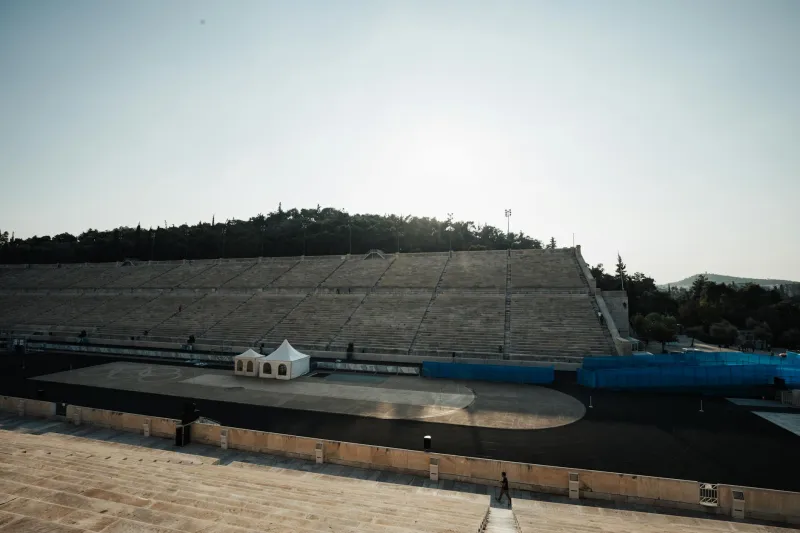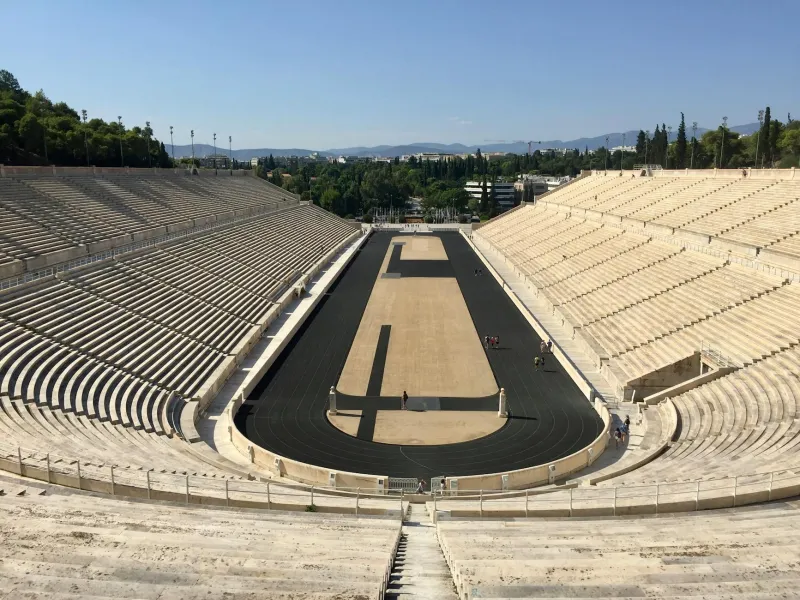
The Moment That Changed Everything
Picture this: It's 776 BC in Olympia, Greece. Twenty of the fastest men in the ancient world are crouched at a marble starting line, muscles coiled like springs. A herald drops his arm, and they explode forward in a cloud of dust. But here's the problem that would puzzle modern sports fans—how do you determine who wins when there are no cameras, no electronic timing, and no slow-motion replay?
The ancient Greeks didn't just solve this problem. They invented the very concept of a decisive finish that defines every sport Americans love today.
Drawing Lines in Sacred Sand
The Greeks understood something fundamental that we take for granted: winning isn't just about being fast—it's about being first to cross a specific point in space. They created the world's first finish lines using simple but brilliant technology: a rope stretched between two posts, positioned exactly one stadion (about 200 meters) from the starting line.
But this wasn't just any rope. It was made from sacred flax and positioned with religious precision. Greek officials, called Hellanodikai, would stand at precise angles to judge the exact moment each runner's torso broke the plane of the rope. No ties were allowed in ancient Greece—there had to be a winner.
This obsession with a definitive finish line reflected something deeper in Greek culture. Unlike modern participation trophy culture, the Greeks believed that competition was meaningless without clear victors. Only the winner received the olive wreath crown. Second place got you nothing but the knowledge that you weren't quite good enough.
The Science of Ancient Judging
Modern Americans might assume that without slow-motion cameras, ancient results were unreliable. Actually, the opposite was true. Greek judges underwent years of training to position themselves at optimal viewing angles. They studied the biomechanics of running and understood that a runner's torso, not their head or feet, was the most reliable indicator of who crossed first.
Archaeological evidence from Olympia reveals that judges stood on elevated platforms positioned at 30-degree angles from the finish line—the exact same positioning that modern track officials use today. The Greeks had figured out, through trial and error, the optimal vantage point for making split-second decisions.
When disputes arose, the Greeks had a backup system that would make modern replay officials jealous. They used multiple judges positioned at different angles, and decisions required consensus. If judges couldn't agree, they would examine the runners' footprints in the sand beyond the finish line to determine who had the most momentum at the moment of crossing.
From Sacred Rope to Photo Finish
That simple rope in ancient Olympia became the DNA for every finish line in American sports. The goal line in football, the finish line at the Boston Marathon, even the tape that breaks across a sprinter's chest—they all trace back to that first sacred rope in Greece.
 Photo: Boston Marathon, via www.maraton.info
But the Greeks gave us something more profound than just a physical marker. They created the psychological framework for how we think about winning. The moment of crossing the line became sacred—a transformation from competitor to champion that happens in an instant.
This is why Americans become obsessed with photo finishes. When swimmers touch the wall within hundredths of a second, or when horses cross the wire in a dead heat, we're witnessing the modern evolution of that ancient Greek moment. The technology has changed, but the fundamental question remains the same: who crossed the line first?
The Winner-Take-All Mentality
American sports culture's obsession with winning—from Little League to the Super Bowl—comes directly from this Greek innovation. Before the Greeks, many ancient cultures celebrated athletic participation or improvement. The Greeks said that wasn't enough. Competition without a clear winner was pointless.
 Photo: Super Bowl, via enjoyorangecounty.com
This mindset shaped everything from how we score games to how we remember athletic achievements. We don't celebrate the fastest losers in Olympic sprints. We remember who crossed the line first, just like the Greeks did 2,800 years ago.
Modern sports psychology confirms what the Greeks intuited: the finish line creates a psychological pressure point that elevates performance. Knowing there's a specific moment and place where victory is decided pushes athletes to dig deeper than they would in open-ended competition.
The Line That Started It All
Today, when an NFL running back stretches the ball across the goal line or a marathoner breaks the tape in Boston, they're participating in a ritual that began in ancient Olympia. The Greeks didn't just create the first finish line—they invented the entire concept that crossing a specific point in space, at a specific moment in time, separates winners from everyone else.
That simple rope stretched between two posts became the foundation for every championship, every record, and every victory celebration in American sports. Because sometimes the most profound innovations are also the most obvious: to have a winner, you need a place where winning happens.
The Greeks drew that line in the sand. We've been racing toward it ever since.