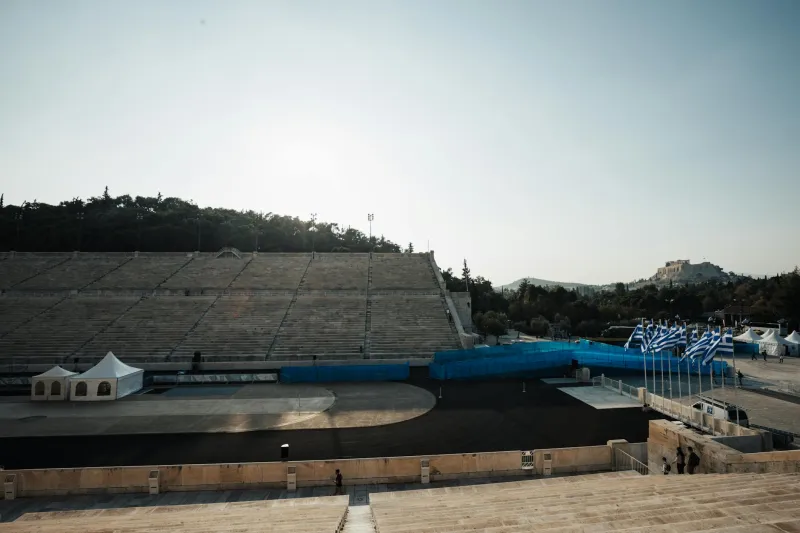
The Stadium That Started It All
When you watch Usain Bolt explode from the blocks at the Olympics, you're witnessing the culmination of nearly 3,000 years of track surface evolution. But the story begins in ancient Olympia, where Greek athletes first discovered that what you run on matters just as much as how fast you can move your legs.
 Photo: Usain Bolt, via cdn.britannica.com
The original Olympic stadion wasn't much to look at—a straight 200-meter stretch of packed earth flanked by grassy hillsides where spectators gathered. No lanes, no synthetic materials, no shock absorption. Just dirt, determination, and the occasional loose stone that could end a runner's career in an instant.
Yet even these ancient Greeks understood something fundamental: the surface beneath an athlete's feet could make or break a performance.
From Sacred Sand to Scientific Precision
Archaeological evidence from Olympia reveals that Greek groundskeepers—yes, they had those—carefully maintained their tracks using techniques that would influence stadium design for millennia. They mixed sand with clay to create a firmer, more consistent surface. They watered the track before competitions to reduce dust and improve footing. They even raked the surface smooth between events.
These weren't random decisions. Greek athletes had figured out that a slightly softer surface reduced impact on their joints during longer races, while a firmer surface provided better energy return for sprinters. Sound familiar? It should—modern track designers use the exact same principles when calibrating the hardness of today's polyurethane surfaces.
The Romans took Greek innovations and scaled them up, as Romans tend to do. The Circus Maximus featured a track surface made from crushed brick and volcanic ash that provided excellent drainage—crucial for a venue that hosted races year-round. Roman engineers also pioneered the use of different surface materials for different types of events, laying the groundwork for the specialized track designs we see today.
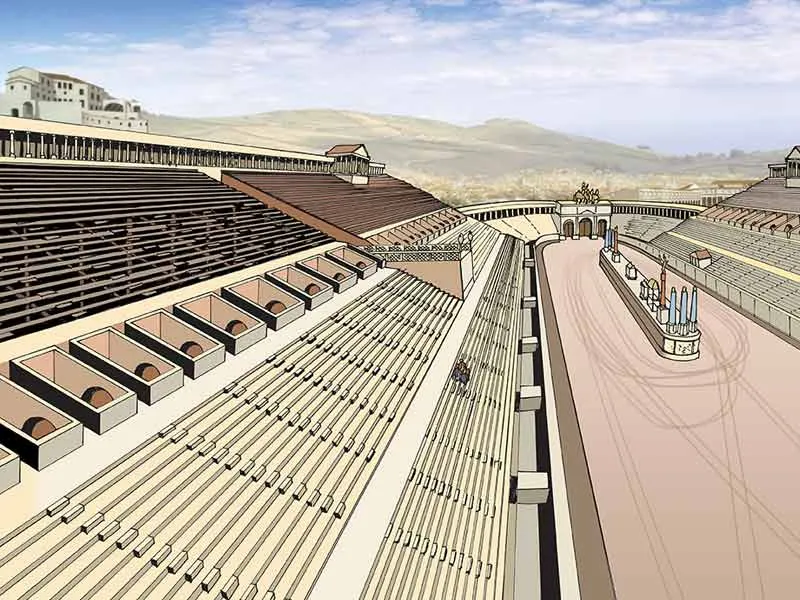 Photo: Circus Maximus, via rome-tourist.com
The American Innovation Gap
For most of American athletic history, we lagged behind in track surface technology. Early American tracks were often just grass fields or cinder paths made from crushed coal slag. Harvard's track, built in 1890, was typical of the era—a quarter-mile oval of packed dirt that turned into a muddy mess whenever it rained.
The breakthrough came in 1963 when the University of Oregon installed the first all-weather synthetic track in America. Made from polyurethane, this surface provided consistent performance regardless of weather conditions. More importantly, it was fast—really fast. Within a decade, world records were falling left and right as athletes discovered what their ancient Greek predecessors had known: the right surface unleashes human potential.
The Science of Speed
Today's Olympic tracks are marvels of engineering that would astound ancient Greek athletes. The surface consists of multiple layers: a base of asphalt or concrete, a shock-absorbing layer of rubber granules, and a top layer of polyurethane mixed with rubber particles for optimal traction and energy return.
But here's the fascinating part: the basic principles haven't changed since Olympia. Modern track designers still balance firmness with shock absorption. They still consider drainage and weather resistance. They still test different materials to find the perfect combination of speed and safety.
The numbers tell the story. Jesse Owens ran his world record 100 meters in 10.2 seconds on a cinder track in 1936. When Usain Bolt set his current world record of 9.58 seconds in 2009, he was running on a Mondo Super X surface specifically engineered to maximize energy return. That's not to diminish Bolt's incredible talent, but the track surface contributed an estimated 0.1 to 0.2 seconds to his performance—the difference between a good time and a world record.
Ancient Wisdom, Modern Application
The most remarkable aspect of this evolution is how ancient Greek innovations continue to influence modern design. When engineers at 3M developed the latest generation of Olympic track surfaces, they studied historical accounts of ancient Greek training methods. They discovered that Greek athletes practiced on different surfaces depending on their event—softer sand for distance runners, harder packed earth for sprinters.
This insight led to the development of "tuned" track surfaces that can be calibrated for specific events. The straightaways might be slightly firmer to maximize sprinting speed, while the curves could be marginally softer to help runners maintain their footing through turns.
The Future Runs on History
As we look toward future Olympics, track surface technology continues to evolve. Researchers are experimenting with carbon fiber elements, advanced polymers, and even surfaces that can adjust their properties in real-time based on temperature and humidity.
But every innovation traces back to those ancient Greek groundskeepers who first understood that athletic greatness doesn't happen in a vacuum—it happens on carefully prepared surfaces that allow human potential to flourish.
The next time you watch an Olympic race, remember that the track beneath those flying feet represents nearly three millennia of human ingenuity, all starting with some Greeks who figured out that mixing sand with clay made their athletes run faster. Sometimes the most revolutionary ideas are also the most obvious ones.